
Ch.12 - Parametric and Polar Curves
Briggs - Calculus: Early Transcendentals 3rd Edition
Briggs3rd EditionCalculus: Early TranscendentalsISBN: 9780136847243Not the one you use?Change textbook
Chapter 12, Problem 12.1.95b

Intersecting lines Consider the following pairs of lines. Determine whether the lines are parallel or intersecting. If the lines intersect, then determine the point of intersection.


b. x = 2 + 5s, y = 1 + s and x = 4 + 10t, y = 3 + 2t

Verified step by step guidance
1
Identify the parametric equations of the two lines: Line 1 is given by \(x = 2 + 5s\), \(y = 1 + s\) and Line 2 is given by \(x = 4 + 10t\), \(y = 3 + 2t\), where \(s\) and \(t\) are parameters.
Check if the lines are parallel by comparing their direction vectors. The direction vector of Line 1 is \(\langle 5, 1 \rangle\) and for Line 2 it is \(\langle 10, 2 \rangle\). Determine if one vector is a scalar multiple of the other.
If the direction vectors are scalar multiples, the lines are parallel. If not, they intersect. Since the direction vectors here appear related, verify by checking if \(\langle 10, 2 \rangle = k \langle 5, 1 \rangle\) for some scalar \(k\).
If the lines intersect, find the point of intersection by setting the parametric equations equal: \(2 + 5s = 4 + 10t\) and \(1 + s = 3 + 2t\). Solve this system of equations for \(s\) and \(t\).
Once you find values for \(s\) and \(t\), substitute back into either parametric equation to find the coordinates \((x, y)\) of the intersection point.

Verified video answer for a similar problem:

This video solution was recommended by our tutors as helpful for the problem above.
Video duration:
2m
Was this helpful?

Key Concepts

Here are the essential concepts you must grasp in order to answer the question correctly.

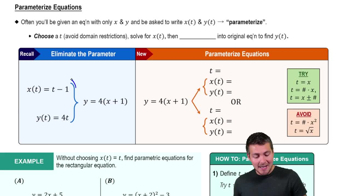
Parametric Equations of Lines

Parametric equations express the coordinates of points on a line as functions of a parameter, typically denoted by variables like s or t. Each parameter value corresponds to a unique point on the line, allowing a clear representation of lines in the plane or space.
Recommended video:
Guided course
08:02
Parameterizing Equations

Determining Parallelism of Lines

Two lines are parallel if their direction vectors are scalar multiples of each other. By comparing the coefficients of the parameters in the parametric equations, one can check if the lines have the same direction, indicating parallelism.
Recommended video:
05:13
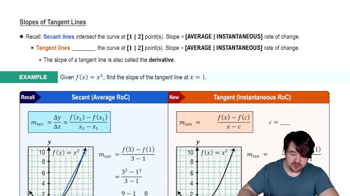
Slopes of Tangent Lines

Finding the Point of Intersection

If lines are not parallel, their point of intersection can be found by equating their parametric expressions and solving the resulting system of equations for the parameters. Substituting these parameter values back into the equations gives the coordinates of the intersection point.
Recommended video:
04:50
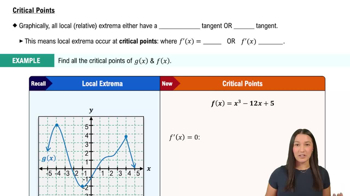
Critical Points