
Ch.12 - Parametric and Polar Curves
Briggs - Calculus: Early Transcendentals 3rd Edition
Briggs3rd EditionCalculus: Early TranscendentalsISBN: 9780136847243Not the one you use?Change textbook
Chapter 12, Problem 12.3.82b

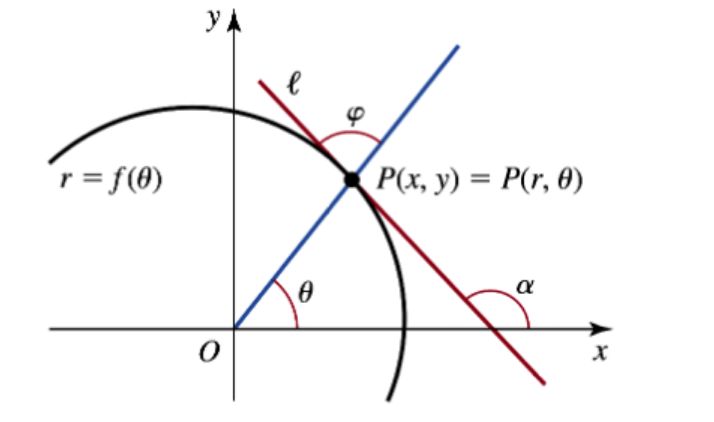
Tangents and normals: Let a polar curve be described by r = f(θ), and let ℓ be the line tangent to the curve at the point P(x,y) = P(r,θ) (see figure).
b. Explain why tan θ = y/x.


Graph of a polar curve r = f(θ) with point P(r, θ), tangent line ℓ, and angles θ, φ, and α marked.

Verified step by step guidance
1
Recall that the point P on the polar curve is given by the coordinates \(P(x,y) = P(r, \theta)\), where \(r = f(\theta)\) is the radius and \(\theta\) is the angle measured from the positive x-axis.
By definition of polar coordinates, the Cartesian coordinates \((x,y)\) of the point \(P\) are related to \(r\) and \(\theta\) by the formulas: \(x = r \cos(\theta)\) and \(y = r \sin(\theta)\).
To find \(\tan(\theta)\), use the ratio of \(y\) to \(x\): \(\tan(\theta) = \frac{y}{x}\).
Substitute the expressions for \(x\) and \(y\) in terms of \(r\) and \(\theta\): \(\tan(\theta) = \frac{r \sin(\theta)}{r \cos(\theta)}\).
Since \(r \neq 0\), the \(r\) cancels out, leaving \(\tan(\theta) = \frac{\sin(\theta)}{\cos(\theta)}\), which is the definition of \(\tan(\theta)\). Therefore, \(\tan(\theta) = \frac{y}{x}\).

Verified video answer for a similar problem:

This video solution was recommended by our tutors as helpful for the problem above.
Video duration:
2m
Was this helpful?

Key Concepts

Here are the essential concepts you must grasp in order to answer the question correctly.

Polar to Cartesian Coordinate Conversion

In polar coordinates, a point is represented as (r, θ), where r is the distance from the origin and θ is the angle from the positive x-axis. The Cartesian coordinates (x, y) can be found using x = r cos θ and y = r sin θ. This conversion is fundamental to relate polar and Cartesian systems.
Recommended video:
05:32
Intro to Polar Coordinates

Definition of the Tangent of an Angle in a Right Triangle

The tangent of an angle θ in a right triangle is defined as the ratio of the length of the side opposite θ to the length of the adjacent side. In the Cartesian plane, for a point (x, y), tan θ = y/x represents the slope of the line from the origin to the point, linking the angle θ to the coordinates.
Recommended video:
05:43
Definition of the Definite Integral

Geometric Interpretation of Angle θ in Polar Coordinates

Angle θ in polar coordinates is the angle between the positive x-axis and the line segment OP connecting the origin to point P. Since tan θ = opposite/adjacent = y/x, this directly follows from the right triangle formed by dropping a perpendicular from P to the x-axis, confirming why tan θ = y/x.
Recommended video:
05:32
Intro to Polar Coordinates
Related Practice
Textbook Question

Volume of a hyperbolic cap Consider the region R bounded by the right branch of the hyperbola x²/a² - y²/b² = 1 and the vertical line through the right focus.

b. What is the volume of the solid that is generated when R is revolved about the y-axis?

Textbook Question

Intersecting lines Consider the following pairs of lines. Determine whether the lines are parallel or intersecting. If the lines intersect, then determine the point of intersection.


b. x = 2 + 5s, y = 1 + s and x = 4 + 10t, y = 3 + 2t

1
views
Textbook Question

67–72. Derivatives Consider the following parametric curves.

b. Make a sketch of the curve showing the tangent line at the point corresponding to the given value of t.


x = 2 + 4t, y = 4 − 8t; t = 2

1
views
Textbook Question

Channel flow Water flows in a shallow semicircular channel with inner and outer radii of 1 m and 2 m (see figure). At a point P(r,θ) in the channel, the flow is in the tangential direction (counterclock wise along circles), and it depends only on r, the distance from the center of the semicircles.


a. Express the region formed by the channel as a set in polar coordinates.

1
views
Textbook Question

Explain why or why not Determine whether the following statements are true and give an explanation or counterexample.


b. An object following the parametric curve x=2cos 2πt, y=2 sin 2πt circles the origin once every 1 time unit.

1
views
Textbook Question

Explain why or why not Determine whether the following statements are true and give an explanation or counterexample.

b. On every ellipse, there are exactly two points at which the curve has slope s, where s is any real number.