Ch.12 - Parametric and Polar Curves
Briggs - Calculus: Early Transcendentals 3rd Edition
Briggs3rd EditionCalculus: Early TranscendentalsISBN: 9780136847243Not the one you use?Change textbook
Chapter 12, Problem 12.3.78c

Spiral arc length Consider the spiral r=4θ, for θ≥0.


c. Show that L′(θ)>0. Is L″(θ) positive or negative? Interpret your answer.

Verified step by step guidance
1
Recall that the arc length function for a curve given in polar coordinates \(r(\theta)\) from \(\theta = a\) to \(\theta = b\) is defined as \(L(\theta) = \int_a^{\theta} \sqrt{r(\phi)^2 + \left(\frac{dr}{d\phi}\right)^2} \, d\phi\). Here, since \(r = 4\theta\), we first find \(\frac{dr}{d\theta} = 4\).
Express the integrand for the arc length derivative \(L'(\theta)\), which is the integrand evaluated at \(\theta\): \(L'(\theta) = \sqrt{r(\theta)^2 + \left(\frac{dr}{d\theta}\right)^2} = \sqrt{(4\theta)^2 + 4^2} = \sqrt{16\theta^2 + 16}\).
To show that \(L'(\theta) > 0\), observe that the expression inside the square root, \(16\theta^2 + 16\), is always positive for \(\theta \geq 0\). Since the square root of a positive number is positive, \(L'(\theta)\) is positive for all \(\theta \geq 0\).
Next, find the second derivative \(L''(\theta)\) by differentiating \(L'(\theta)\) with respect to \(\theta\): \(L''(\theta) = \frac{d}{d\theta} \left( \sqrt{16\theta^2 + 16} \right)\). Use the chain rule to differentiate this expression.
Interpret the sign of \(L''(\theta)\): if \(L''(\theta)\) is positive, the rate of change of the arc length is increasing, meaning the spiral is stretching out faster as \(\theta\) increases; if negative, the rate of change is slowing down. Analyze the derivative expression to determine the sign and provide this interpretation.

Verified video answer for a similar problem:

This video solution was recommended by our tutors as helpful for the problem above.
Video duration:
6m
Was this helpful?

Key Concepts

Here are the essential concepts you must grasp in order to answer the question correctly.

Arc Length of a Polar Curve

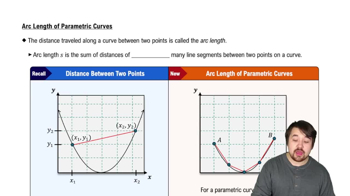
The arc length L(θ) of a curve defined in polar coordinates r(θ) is found by integrating the square root of the sum of the squares of r(θ) and its derivative r'(θ). Specifically, the formula is L(θ) = ∫√[r(θ)² + (dr/dθ)²] dθ. Understanding this formula is essential to analyze how the length changes with θ.
Recommended video:
06:29
Arc Length of Parametric Curves

First Derivative of Arc Length (L′(θ))

L′(θ) represents the rate of change of the arc length with respect to θ. Since arc length accumulates as θ increases, L′(θ) is typically positive, indicating the curve is continuously extending. Showing L′(θ) > 0 confirms the spiral is growing in length as θ increases.
Recommended video:
06:29
Arc Length of Parametric Curves

Second Derivative of Arc Length (L″(θ)) and Its Interpretation

L″(θ) measures the concavity or acceleration of the arc length growth. A positive L″(θ) means the length is increasing at an increasing rate, while a negative L″(θ) means the length is increasing but at a decreasing rate. Interpreting L″(θ) helps understand how the spiral’s growth speed changes with θ.
Recommended video:
06:02
The Second Derivative Test: Finding Local Extrema