Ch.12 - Parametric and Polar Curves
Briggs - Calculus: Early Transcendentals 3rd Edition
Briggs3rd EditionCalculus: Early TranscendentalsISBN: 9780136847243Not the one you use?Change textbook
Chapter 12, Problem 12.R.60a

A polar conic section Consider the equation r² = sec2θ
a. Convert the equation to Cartesian coordinates and identify the curve.

Verified step by step guidance
1
Recall the relationships between polar and Cartesian coordinates: \(x = r \cos\theta\), \(y = r \sin\theta\), and \(r^2 = x^2 + y^2\).
Given the equation \(r^2 = \sec^2\theta\), rewrite \(\sec^2\theta\) as \(\frac{1}{\cos^2\theta}\), so the equation becomes \(r^2 = \frac{1}{\cos^2\theta}\).
Multiply both sides by \(\cos^2\theta\) to get \(r^2 \cos^2\theta = 1\).
Substitute \(r \cos\theta\) with \(x\) (since \(x = r \cos\theta\)), so the equation becomes \(x^2 = 1\).
Interpret the Cartesian equation \(x^2 = 1\) as two vertical lines \(x = 1\) and \(x = -1\), which are the Cartesian form of the given polar equation.

Verified video answer for a similar problem:

This video solution was recommended by our tutors as helpful for the problem above.
Video duration:
5m
Was this helpful?

Key Concepts

Here are the essential concepts you must grasp in order to answer the question correctly.

Polar to Cartesian Coordinate Conversion

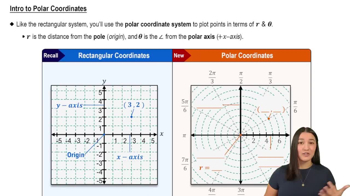
This involves expressing polar coordinates (r, θ) in terms of Cartesian coordinates (x, y) using the relationships x = r cos θ and y = r sin θ. Converting polar equations to Cartesian form helps in identifying and analyzing curves using familiar algebraic methods.
Recommended video:
05:32
Intro to Polar Coordinates

Trigonometric Identities

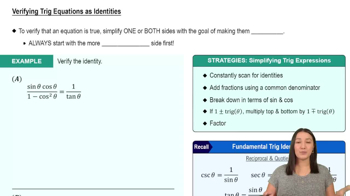
Trigonometric identities, such as sec²θ = 1/cos²θ and the Pythagorean identity sin²θ + cos²θ = 1, are essential for manipulating and simplifying equations involving trigonometric functions. These identities enable rewriting the given polar equation into a more workable form.
Recommended video:
7:17
Verifying Trig Equations as Identities

Identification of Conic Sections

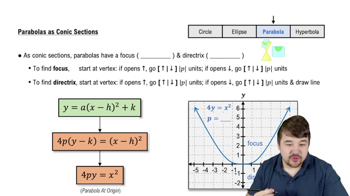
Conic sections include ellipses, parabolas, and hyperbolas, each with characteristic Cartesian equations. After converting the polar equation, recognizing the standard form of these curves allows one to classify the curve correctly based on its algebraic equation.
Recommended video:
5:33
Parabolas as Conic Sections