Ch.12 - Parametric and Polar Curves
Briggs - Calculus: Early Transcendentals 3rd Edition
Briggs3rd EditionCalculus: Early TranscendentalsISBN: 9780136847243Not the one you use?Change textbook
Chapter 12, Problem 12.R.41b

40–41. {Use of Tech} Slopes of tangent lines
b. Find the slope of the lines tangent to the curve at the origin (when relevant).
r = 1 −sin θ

Verified step by step guidance
1
Recognize that the given curve is in polar form: \(r = 1 - \sin \theta\). To find the slope of the tangent line at a point, we need to convert this polar equation into Cartesian coordinates or use the formula for the slope of a tangent line in polar coordinates.
Recall that the slope of the tangent line in Cartesian coordinates is \(\frac{dy}{dx}\). For polar curves, \(x = r \cos \theta\) and \(y = r \sin \theta\). Therefore, \(\frac{dy}{dx} = \frac{\frac{dy}{d\theta}}{\frac{dx}{d\theta}}\).
Compute \(\frac{dx}{d\theta}\) and \(\frac{dy}{d\theta}\) using the product and chain rules: \(\frac{dx}{d\theta} = \frac{d}{d\theta}(r \cos \theta) = \frac{dr}{d\theta} \cos \theta - r \sin \theta\), \(\frac{dy}{d\theta} = \frac{d}{d\theta}(r \sin \theta) = \frac{dr}{d\theta} \sin \theta + r \cos \theta\).
Find \(\frac{dr}{d\theta}\) by differentiating \(r = 1 - \sin \theta\) with respect to \(\theta\), which gives \(\frac{dr}{d\theta} = -\cos \theta\).
Evaluate \(\frac{dy}{dx} = \frac{\frac{dy}{d\theta}}{\frac{dx}{d\theta}}\) at the origin. Since the origin corresponds to \(r=0\), find the value(s) of \(\theta\) where \(r=0\) (i.e., solve \(1 - \sin \theta = 0\)), then substitute those \(\theta\) values into the expressions for \(\frac{dy}{d\theta}\) and \(\frac{dx}{d\theta}\) to find the slope(s) of the tangent line(s) at the origin.

Verified video answer for a similar problem:

This video solution was recommended by our tutors as helpful for the problem above.
Video duration:
3m
Was this helpful?

Key Concepts

Here are the essential concepts you must grasp in order to answer the question correctly.

Polar Coordinates and Curves

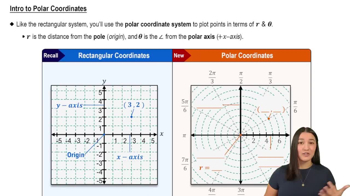
Polar coordinates represent points using a radius and an angle (r, θ) instead of Cartesian (x, y). Understanding how to interpret and manipulate polar equations like r = 1 − sin θ is essential for analyzing curves defined in this system.
Recommended video:
05:32
Intro to Polar Coordinates

Slope of Tangent Lines in Polar Coordinates

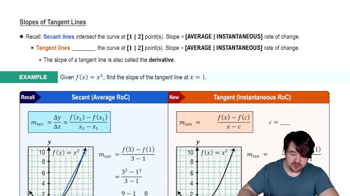
The slope of a tangent line to a polar curve at a given point can be found by converting the polar equation to Cartesian form or using the formula dy/dx = (dr/dθ sin θ + r cos θ) / (dr/dθ cos θ − r sin θ). This allows calculation of the slope at specific θ values.
Recommended video:
05:13
Slopes of Tangent Lines

Finding Tangent Lines at the Origin

When the curve passes through the origin (r = 0), special attention is needed to find the tangent slope, often by evaluating limits or using derivatives with respect to θ. This helps determine the direction of the tangent line at the origin.
Recommended video:
05:13
Slopes of Tangent Lines