Ch.12 - Parametric and Polar Curves
Briggs - Calculus: Early Transcendentals 3rd Edition
Briggs3rd EditionCalculus: Early TranscendentalsISBN: 9780136847243Not the one you use?Change textbook
Chapter 12, Problem 12.R.12a

10–12. Parametric curves
a. Eliminate the parameter to obtain an equation in x and y.
x = ln t, y = 8ln t², for 1 ≤ t ≤ e²; (1, 16)

Verified step by step guidance
1
Start with the given parametric equations: \(x = \ln t\) and \(y = 8 \ln t^{2}\), where \(1 \leq t \leq e^{2}\).
Recall the logarithm property: \(\ln t^{2} = 2 \ln t\). Use this to rewrite \(y\) as \(y = 8 \times 2 \ln t = 16 \ln t\).
Since \(x = \ln t\), substitute \(\ln t\) in the expression for \(y\) to get \(y = 16x\).
This gives the Cartesian equation relating \(x\) and \(y\) without the parameter \(t\): \(y = 16x\).
Note the domain for \(t\) translates to \(x\) because \(x = \ln t\). Since \(1 \leq t \leq e^{2}\), then \(0 \leq x \leq 2\).

Verified video answer for a similar problem:

This video solution was recommended by our tutors as helpful for the problem above.
Video duration:
2m
Was this helpful?

Key Concepts

Here are the essential concepts you must grasp in order to answer the question correctly.

Parametric Equations

Parametric equations express the coordinates of points on a curve as functions of a parameter, usually denoted t. Instead of y as a function of x, both x and y depend on t, allowing the description of more complex curves and motions.
Recommended video:
Guided course
08:02
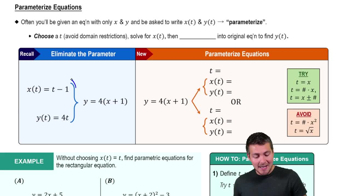
Parameterizing Equations

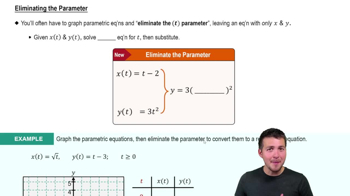
Eliminating the Parameter

Eliminating the parameter involves manipulating the parametric equations to remove the parameter t, resulting in a direct relationship between x and y. This often requires solving one equation for t and substituting into the other to find an explicit or implicit equation in x and y.
Recommended video:
Guided course
05:59
Eliminating the Parameter

Logarithmic Functions and Their Properties

Logarithmic functions, like ln(t), are the inverses of exponential functions and have properties such as ln(a^b) = b ln(a). Understanding these properties is essential for simplifying expressions and eliminating parameters when the parametric equations involve logarithms.
Recommended video:
06:21
Properties of Functions