Ch.12 - Parametric and Polar Curves
Briggs - Calculus: Early Transcendentals 3rd Edition
Briggs3rd EditionCalculus: Early TranscendentalsISBN: 9780136847243Not the one you use?Change textbook
Chapter 12, Problem 12.3.85

85–87. Grazing goat problems Consider the following sequence of problems related to grazing goats tied to a rope. (See the Guided Project Grazing goat problems.)


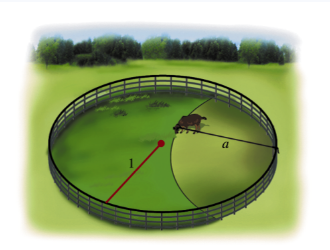
A circular corral of unit radius is enclosed by a fence. A goat inside the corral is tied to the fence with a rope of length 0≤a≤2 (see figure). What is the area of the region (inside the corral) that the goat can graze? Check your answer with the special cases a=0 and a=2.


Circular corral with radius 1, a goat tied to the fence by rope length a, showing grazing area inside.

Verified step by step guidance
1
Step 1: Understand the problem setup. The corral is a circle with radius 1, and the goat is tied to the fence (the boundary of the circle) with a rope of length \(a\), where \(0 \leq a \leq 2\). We want to find the area inside the corral that the goat can graze, i.e., the area reachable by the goat within the corral boundary.
Step 2: Visualize the grazing area. The goat is tied at a point on the circle's boundary. The grazing area is the intersection of two circles: the corral circle with radius 1 centered at the origin, and the goat's reachable circle with radius \(a\) centered at the point on the corral boundary where the goat is tied (distance 1 from the origin).
Step 3: Set up the equations for the two circles. Let the goat be tied at point \((1,0)\) on the x-axis for simplicity. Then the corral circle is \(x^2 + y^2 = 1\), and the goat's grazing circle is \((x - 1)^2 + y^2 = a^2\).
Step 4: Find the area of intersection of these two circles. This area can be found by calculating the sum of two circular segments formed by the intersection points. Use the formula for the area of intersection of two circles with radii \(r_1\) and \(r_2\) and distance \(d\) between centers:
\[ A = r_1^2 \cos^{-1} \left( \frac{d^2 + r_1^2 - r_2^2}{2 d r_1} \right) + r_2^2 \cos^{-1} \left( \frac{d^2 + r_2^2 - r_1^2}{2 d r_2} \right) - \frac{1}{2} \sqrt{(-d + r_1 + r_2)(d + r_1 - r_2)(d - r_1 + r_2)(d + r_1 + r_2)} \]
Step 5: Substitute \(r_1 = 1\), \(r_2 = a\), and \(d = 1\) into the formula to express the grazing area as a function of \(a\). Check the special cases: when \(a=0\), the grazing area should be 0, and when \(a=2\), the grazing area should be the entire corral area, which is \(\pi\).

Verified video answer for a similar problem:

This video solution was recommended by our tutors as helpful for the problem above.
Video duration:
3m
Was this helpful?

Key Concepts

Here are the essential concepts you must grasp in order to answer the question correctly.

Geometry of Circles and Circular Segments

Understanding the properties of circles, including radius, chords, and arcs, is essential. The grazing area is a portion of the circle defined by the rope length and the corral's boundary, often involving circular segments or sectors.
Recommended video:
06:35
Changing Geometries

Area Calculation Using Integration

Calculus, particularly integration, is used to find the area of irregular shapes like the grazing region. Setting up integrals based on the geometry of the problem allows precise calculation of the area accessible to the goat.
Recommended video:
07:59
Estimating the Area Under a Curve Using Left Endpoints

Boundary Conditions and Special Cases

Analyzing special cases such as when the rope length is zero or equals the diameter helps verify the solution. These boundary conditions simplify the problem and provide checks for the general formula.
Recommended video:
04:24
Graphing The Derivative - Special Cases