Ch.12 - Parametric and Polar Curves
Briggs - Calculus: Early Transcendentals 3rd Edition
Briggs3rd EditionCalculus: Early TranscendentalsISBN: 9780136847243Not the one you use?Change textbook
Chapter 12, Problem 12.1.88

81–88. Arc length Find the arc length of the following curves on the given interval.


x = sin t, y = t - cos t; 0 ≤ t ≤ π/2

Verified step by step guidance
1
Recall the formula for the arc length of a parametric curve given by \(x = x(t)\) and \(y = y(t)\) over the interval \(a \leq t \leq b\): \[L = \int_a^b \sqrt{\left(\frac{dx}{dt}\right)^2 + \left(\frac{dy}{dt}\right)^2} \, dt\]
Identify the given functions: \(x(t) = \sin t\) \(y(t) = t - \cos t\) and the interval: \(0 \leq t \leq \frac{\pi}{2}\)
Compute the derivatives of \(x(t)\) and \(y(t)\) with respect to \(t\): \[\frac{dx}{dt} = \cos t\] \[\frac{dy}{dt} = 1 + \sin t\]
Substitute the derivatives into the arc length formula under the square root: \[\sqrt{(\cos t)^2 + (1 + \sin t)^2} = \sqrt{\cos^2 t + (1 + \sin t)^2}\]
Simplify the expression inside the square root as much as possible before integrating, then set up the integral for the arc length: \[L = \int_0^{\frac{\pi}{2}} \sqrt{\cos^2 t + (1 + \sin t)^2} \, dt\] This integral can then be evaluated to find the arc length.

Verified video answer for a similar problem:

This video solution was recommended by our tutors as helpful for the problem above.
Video duration:
5m
Was this helpful?

Key Concepts

Here are the essential concepts you must grasp in order to answer the question correctly.

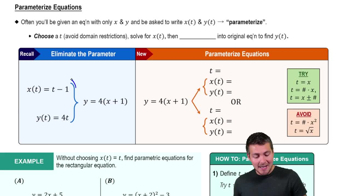
Parametric Equations

Parametric equations express the coordinates of points on a curve as functions of a parameter, often denoted t. Here, x and y are given in terms of t, allowing the curve to be analyzed by studying these functions over the specified interval.
Recommended video:
Guided course
08:02
Parameterizing Equations

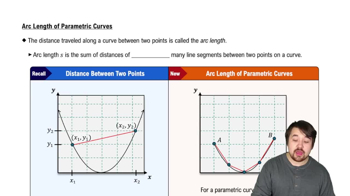
Arc Length Formula for Parametric Curves

The arc length of a curve defined parametrically by x(t) and y(t) from t = a to t = b is found by integrating the square root of the sum of the squares of the derivatives: ∫ from a to b √[(dx/dt)² + (dy/dt)²] dt. This formula measures the distance along the curve.
Recommended video:
06:29
Arc Length of Parametric Curves

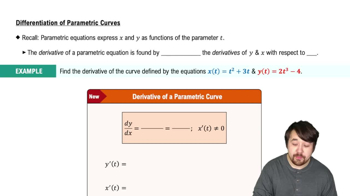
Differentiation of Parametric Functions

To apply the arc length formula, one must compute the derivatives dx/dt and dy/dt accurately. Differentiation rules for trigonometric and polynomial functions are used here to find these derivatives, which are essential for evaluating the integral.
Recommended video:
06:49
Differentiation of Parametric Curves
Related Practice
Textbook Question

73–76. Tangent lines Find an equation of the line tangent to the curve at the point corresponding to the given value of t.


x=cos t+t sin t,y=sin t−t cos t; t=π/4

Textbook Question

85–87. Grazing goat problems Consider the following sequence of problems related to grazing goats tied to a rope. (See the Guided Project Grazing goat problems.)


A circular corral of unit radius is enclosed by a fence. A goat inside the corral is tied to the fence with a rope of length 0≤a≤2 (see figure). What is the area of the region (inside the corral) that the goat can graze? Check your answer with the special cases a=0 and a=2.


Textbook Question

90–94. Focal chords A focal chord of a conic section is a line through a focus joining two points of the curve. The latus rectum is the focal chord perpendicular to the major axis of the conic. Prove the following properties.

Let L be the latus rectum of the parabola y ² =4px for p>0. Let F be the focus of the parabola, P be any point on the parabola to the left of L, and D be the (shortest) distance between P and L. Show that for all P, D+|FP|+ is a constant. Find the constant.

Textbook Question

90–94. Focal chords A focal chord of a conic section is a line through a focus joining two points of the curve. The latus rectum is the focal chord perpendicular to the major axis of the conic. Prove the following properties.

The length of the latus rectum of the parabola y ² =4px or x ² =4py is 4|p|.

Textbook Question

49–52. Cartesian-to-polar coordinates Convert the following equations to polar coordinates.


(x - 1)² + y² = 1

1
views
Textbook Question

Spiral arc length Consider the spiral r=4θ, for θ≥0.


a. Use a trigonometric substitution to find the length of the spiral, for 0≤θ≤√8.