Ch.12 - Parametric and Polar Curves
Briggs - Calculus: Early Transcendentals 3rd Edition
Briggs3rd EditionCalculus: Early TranscendentalsISBN: 9780136847243Not the one you use?Change textbook
Chapter 12, Problem 12.1.75

73–76. Tangent lines Find an equation of the line tangent to the curve at the point corresponding to the given value of t.


x=cos t+t sin t,y=sin t−t cos t; t=π/4

Verified step by step guidance
1
Identify the parametric equations given: \(x = \cos t + t \sin t\) and \(y = \sin t - t \cos t\).
Find the derivatives of \(x\) and \(y\) with respect to \(t\): compute \(\frac{dx}{dt}\) and \(\frac{dy}{dt}\) using the product rule where necessary.
Evaluate \(\frac{dx}{dt}\) and \(\frac{dy}{dt}\) at \(t = \frac{\pi}{4}\) to find the slope of the tangent line using \(\frac{dy}{dx} = \frac{\frac{dy}{dt}}{\frac{dx}{dt}}\).
Calculate the coordinates of the point on the curve at \(t = \frac{\pi}{4}\) by substituting \(t\) into the original parametric equations to get \((x_0, y_0)\).
Use the point-slope form of the line equation: \(y - y_0 = m(x - x_0)\), where \(m\) is the slope found in step 3, to write the equation of the tangent line.

Verified video answer for a similar problem:

This video solution was recommended by our tutors as helpful for the problem above.
Video duration:
11m
Was this helpful?

Key Concepts

Here are the essential concepts you must grasp in order to answer the question correctly.

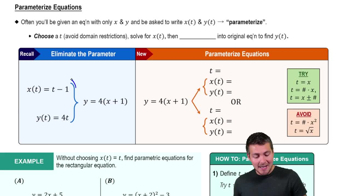
Parametric Equations

Parametric equations express the coordinates of points on a curve as functions of a parameter, often denoted as t. Instead of y as a function of x, both x and y depend on t, allowing the description of more complex curves. Understanding how to work with these equations is essential for finding derivatives and tangent lines.
Recommended video:
Guided course
08:02
Parameterizing Equations

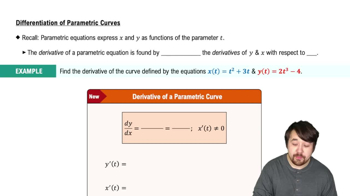
Derivative of Parametric Curves

To find the slope of the tangent line to a parametric curve, compute dy/dx by dividing dy/dt by dx/dt, provided dx/dt ≠ 0. This method uses the chain rule and allows determination of the instantaneous rate of change of y with respect to x at a given parameter value.
Recommended video:
06:49
Differentiation of Parametric Curves

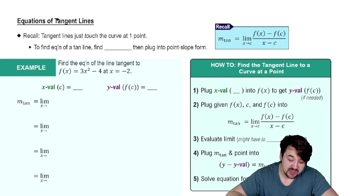
Equation of a Tangent Line

Once the slope of the tangent line at a point is found, the tangent line's equation can be written using the point-slope form: y - y₀ = m(x - x₀), where (x₀, y₀) is the point on the curve and m is the slope. This equation represents the line that just touches the curve at that point.
Recommended video:
05:14
Equations of Tangent Lines
Related Practice
Textbook Question

57–62. Polar equations for conic sections Graph the following conic sections, labeling the vertices, foci, directrices, and asymptotes (if they exist). Use a graphing utility to check your work.


r = 1/(2 - 2 sin θ)

Textbook Question

81–88. Arc length Find the arc length of the following curves on the given interval.


x = sin t, y = t - cos t; 0 ≤ t ≤ π/2

Textbook Question

90–94. Focal chords A focal chord of a conic section is a line through a focus joining two points of the curve. The latus rectum is the focal chord perpendicular to the major axis of the conic. Prove the following properties.

Let L be the latus rectum of the parabola y ² =4px for p>0. Let F be the focus of the parabola, P be any point on the parabola to the left of L, and D be the (shortest) distance between P and L. Show that for all P, D+|FP|+ is a constant. Find the constant.

Textbook Question

90–94. Focal chords A focal chord of a conic section is a line through a focus joining two points of the curve. The latus rectum is the focal chord perpendicular to the major axis of the conic. Prove the following properties.

The length of the latus rectum of the parabola y ² =4px or x ² =4py is 4|p|.

Textbook Question

49–52. Cartesian-to-polar coordinates Convert the following equations to polar coordinates.


(x - 1)² + y² = 1

1
views
Textbook Question

Spiral arc length Consider the spiral r=4θ, for θ≥0.


a. Use a trigonometric substitution to find the length of the spiral, for 0≤θ≤√8.