
Textbook Question
11–20. Slopes of tangent lines Find the slope of the line tangent to the following polar curves at the given points.
r = 4 + sin θ; (4, 0) and (3, 3π/2)

 Verified step by step guidance
 5:59
5:59
 5:22
5:22 05:32
05:3211–20. Slopes of tangent lines Find the slope of the line tangent to the following polar curves at the given points.
r = 4 + sin θ; (4, 0) and (3, 3π/2)
37–48. Polar-to-Cartesian coordinates Convert the following equations to Cartesian coordinates. Describe the resulting curve.
r cos θ = -4
31–38. Equations of parabolas Find an equation of the following parabolas. Unless otherwise specified, assume the vertex is at the origin.
A parabola that opens to the right with directrix x = -4
39–50. Equations of ellipses and hyperbolas Find an equation of the following ellipses and hyperbolas, assuming the center is at the origin.
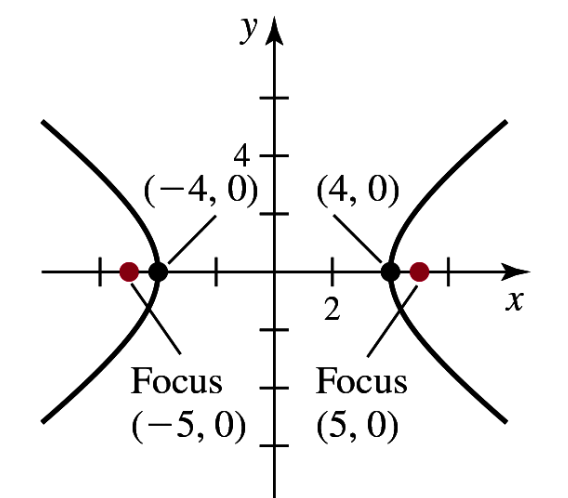
A hyperbola with vertices (±4, 0) and foci (±6, 0)
15–22. Sets in polar coordinates Sketch the following sets of points.
r = 3
85–87. Grazing goat problems Consider the following sequence of problems related to grazing goats tied to a rope. (See the Guided Project Grazing goat problems.)
A circular corral of unit radius is enclosed by a fence. A goat inside the corral is tied to the fence with a rope of length 0≤a≤2 (see figure). What is the area of the region (inside the corral) that the goat can graze? Check your answer with the special cases a=0 and a=2.