
Ch. 9 - Differential Equations
Briggs - Calculus: Early Transcendentals 3rd Edition
Briggs3rd EditionCalculus: Early TranscendentalsISBN: 9780136847243Not the one you use?Change textbook
Chapter 9, Problem 9.4.35b

Explain why or why not Determine whether the following statements are true and give an explanation or counterexample


b. If k>0 and b>0 then y(t)=0 is never a solution of y'(t)=ky−b.

Verified step by step guidance
1
Start by writing down the differential equation: \(y'(t) = k y - b\), where \(k > 0\) and \(b > 0\).
Check if \(y(t) = 0\) can be a solution by substituting \(y(t) = 0\) into the differential equation: compute \(y'(t)\) when \(y(t) = 0\).
Substitute \(y(t) = 0\) into the right-hand side: \(k \cdot 0 - b = -b\). Since \(b > 0\), this equals \(-b < 0\).
Note that if \(y(t) = 0\) were a solution, then \(y'(t)\) would have to be equal to the right-hand side evaluated at \(y=0\), but \(y'(t)\) would be zero (since \(y(t)\) is constant zero), which contradicts \(y'(t) = -b\).
Conclude that \(y(t) = 0\) is not a solution of the differential equation when \(k > 0\) and \(b > 0\), because the derivative condition is not satisfied.

Verified video answer for a similar problem:

This video solution was recommended by our tutors as helpful for the problem above.
Video duration:
1m
Was this helpful?

Key Concepts

Here are the essential concepts you must grasp in order to answer the question correctly.

Differential Equations and Their Solutions

A differential equation relates a function and its derivatives. Solutions are functions that satisfy the equation when substituted. Understanding how to verify if a function is a solution involves substituting it into the equation and checking if both sides are equal.
Recommended video:
04:00
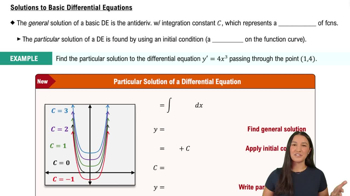
Solutions to Basic Differential Equations

Equilibrium (Constant) Solutions

Equilibrium solutions occur when the derivative equals zero, meaning the function is constant over time. For y'(t) = ky - b, setting y'(t) = 0 helps find constant solutions y = b/k. Recognizing these helps determine if y(t) = 0 can be a solution.
Recommended video:
04:00
Solutions to Basic Differential Equations

Substitution and Counterexamples

To test if y(t) = 0 is a solution, substitute y = 0 into the differential equation. If the resulting equality holds, it is a solution; otherwise, it is not. Providing a counterexample involves showing a specific case where the statement fails.
Recommended video:
04:27
Substitution With an Extra Variable
Related Practice
Textbook Question

{Use of Tech} Intravenous drug dosing The amount of drug in the blood of a patient (in milligrams) administered via an intravenous line is governed by the initial value problem y’(t) = -0.02y + 3, y(0) = 0 where t is measured in hours.


b. What is the steady-state level of the drug?

1
views
Textbook Question

38–43. Equilibrium solutions A differential equation of the form y′(t)=f(y) is said to be autonomous (the function f depends only on y). The constant function y=y0 is an equilibrium solution of the equation provided f(y0)=0 (because then y'(t)=0 and the solution remains constant for all t). Note that equilibrium solutions correspond to horizontal lines in the direction field. Note also that for autonomous equations, the direction field is independent of t. Carry out the following analysis on the given equations.

a. Find the equilibrium solutions. 


y′(t) = y(y - 3)(y + 2)

1
views
Textbook Question

29–32. {Use of Tech} Errors in Euler’s method Consider the following initial value problems.


a. Find the approximations to y(0.2) and y(0.4) using Euler’s method with time steps of Δt = 0.2, 0.1, 0.05, and 0.025.


y′(t) = y/2, y(0) = 2; y(t) = 2eᵗᐟ²

Textbook Question

23–26. Stirred tank reactions For each of the following stirred tank reactions, carry out the following analysis.

a. Write an initial value problem for the mass of the substance.


A one-million-liter pond is contaminated by a chemical pollutant with a concentration of 20 g/L. The source of the pollutant is removed, and pure water is allowed to flow into the pond at a rate of 1200 L/hr. Assuming the pond is thoroughly mixed and drained at a rate of 1200 L/hr, how long does it take to reduce the concentration of the solution in the pond to 10% of the initial value?

Textbook Question

A bad loan Consider a loan repayment plan described by the initial value problem

B'(t)=0.03B−600,B(0)=40,000,

where the amount borrowed is B(0)=\$40,000, the monthly payments are \$600, and B(t) is the unpaid balance in the loan.

b. What is the most that you can borrow under the terms of this loan without going further into debt each month?

1
views
Textbook Question

Convergence of Euler's method Suppose Euler's method is applied to the initial value problem y′(t) = ay, y(0) = 1, which has the exact solution y(t) = eᵃᵗ. For this exercise, let h denote the time step (rather than Δt). The grid points are then given by tₖ = kh. We let uₖ be the Euler approximation to the exact solution y(tₖ), for k = 0, 1, 2, ...

b. Show by substitution that uₖ = (1 + ah)ᵏ is a solution of the equations in part (a), for k = 0, 1, 2, ...