
Ch. 9 - Differential Equations
Briggs - Calculus: Early Transcendentals 3rd Edition
Briggs3rd EditionCalculus: Early TranscendentalsISBN: 9780136847243Not the one you use?Change textbook
Chapter 9, Problem 9.5.26a

23–26. Stirred tank reactions For each of the following stirred tank reactions, carry out the following analysis.
a. Write an initial value problem for the mass of the substance.


A one-million-liter pond is contaminated by a chemical pollutant with a concentration of 20 g/L. The source of the pollutant is removed, and pure water is allowed to flow into the pond at a rate of 1200 L/hr. Assuming the pond is thoroughly mixed and drained at a rate of 1200 L/hr, how long does it take to reduce the concentration of the solution in the pond to 10% of the initial value?

Verified step by step guidance
1
Define the variable \(m(t)\) as the mass of the pollutant in the pond at time \(t\) (in hours). Since the pond volume is constant at 1,000,000 liters, the concentration at time \(t\) is \(c(t) = \frac{m(t)}{1,000,000}\) grams per liter.
Set up the initial condition: at time \(t=0\), the mass of pollutant is \(m(0) = 20 \text{ g/L} \times 1,000,000 \text{ L} = 20,000,000\) grams.
Write the rate of change of mass \(\frac{dm}{dt}\) considering the inflow and outflow. Since pure water flows in, no pollutant enters, so the inflow term is zero. The outflow removes pollutant at a rate proportional to the concentration and the outflow rate: \(\frac{dm}{dt} = - (\text{outflow rate}) \times c(t) = -1200 \times \frac{m(t)}{1,000,000}\).
Formulate the initial value problem (IVP) as the differential equation: \(\frac{dm}{dt} = -\frac{1200}{1,000,000} m(t)\) with initial condition \(m(0) = 20,000,000\).
To find the time \(t\) when the concentration is 10% of the initial value, set \(c(t) = 0.1 \times 20 = 2\) g/L, which means \(m(t) = 2 \times 1,000,000 = 2,000,000\) grams. Solve the IVP for \(m(t)\) and then solve for \(t\) when \(m(t) = 2,000,000\).

Verified video answer for a similar problem:

This video solution was recommended by our tutors as helpful for the problem above.
Video duration:
4m
Was this helpful?

Key Concepts

Here are the essential concepts you must grasp in order to answer the question correctly.

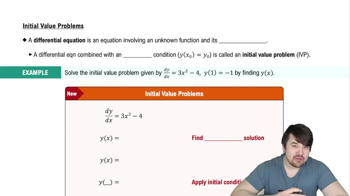
Formulating Initial Value Problems (IVPs)

An initial value problem involves setting up a differential equation that models the rate of change of a quantity along with an initial condition. In this context, it means expressing how the mass of the pollutant changes over time based on inflow, outflow, and mixing, starting from the known initial mass.
Recommended video:
05:03
Initial Value Problems

Mixing and Flow in Stirred Tank Models

A stirred tank model assumes the contents are perfectly mixed, so the concentration is uniform throughout. The inflow and outflow rates affect the concentration by diluting or removing the substance, and the volume remains constant if inflow equals outflow, simplifying the mass balance.
Recommended video:
09:29
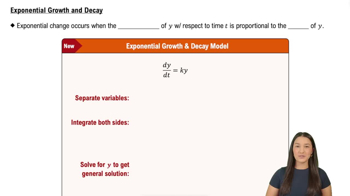
Exponential Growth & Decay

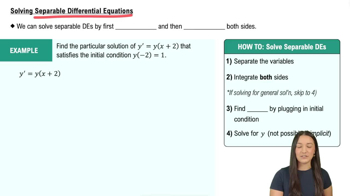
Solving First-Order Linear Differential Equations

The mass or concentration change in the pond can be described by a first-order linear differential equation. Solving this equation involves integrating to find the concentration as a function of time, which allows determining how long it takes for the concentration to reach a specified fraction of its initial value.
Recommended video:
06:06
Solving Separable Differential Equations
Related Practice
Textbook Question

38–43. Equilibrium solutions A differential equation of the form y′(t)=f(y) is said to be autonomous (the function f depends only on y). The constant function y=y0 is an equilibrium solution of the equation provided f(y0)=0 (because then y'(t)=0 and the solution remains constant for all t). Note that equilibrium solutions correspond to horizontal lines in the direction field. Note also that for autonomous equations, the direction field is independent of t. Carry out the following analysis on the given equations.

a. Find the equilibrium solutions. 


y′(t) = y(y - 3)(y + 2)

1
views
Textbook Question

Explain why or why not Determine whether the following statements are true and give an explanation or counterexample


b. If k>0 and b>0 then y(t)=0 is never a solution of y'(t)=ky−b.

1
views
Textbook Question

17–20. Increasing and decreasing solutions Consider the following differential equations. A detailed direction field is not needed.


a. Find the solutions that are constant, for all t ≥ 0 (the equilibrium solutions).


y'(t) = (y−2)(y+1)

1
views
Textbook Question

29–32. {Use of Tech} Errors in Euler’s method Consider the following initial value problems.


a. Find the approximations to y(0.2) and y(0.4) using Euler’s method with time steps of Δt = 0.2, 0.1, 0.05, and 0.025.


y′(t) = y/2, y(0) = 2; y(t) = 2eᵗᐟ²

Textbook Question

33–36. {Use of Tech} Computing Euler approximations Use a calculator or computer program to carry out the following steps.

a. Approximate the value of y(T) using Euler’s method with the given time step on the interval [0,T].


y′(t) = t/y, y(0) = 4; Δt = 0.1, T = 2; y(t) = √(t² + 16)

Textbook Question

{Use of Tech} Endowment model An endowment is an investment account in which the balance ideally remains constant and withdrawals are made on the interest earned by the account. Such an account may be modeled by the initial value problem B′(t)=rB−m, for t≥0, with B(0)=B0. The constant r>0 reflects the annual interest rate, m>0 is the annual rate of withdrawal, B0 is the initial balance in the account, and t is measured in years.


a. Solve the initial value problem with r=0.05, m=\(1000/year, and B0=\)15,000 Does the balance in the account increase or decrease?

1
views