
Ch. 9 - Differential Equations
Briggs - Calculus: Early Transcendentals 3rd Edition
Briggs3rd EditionCalculus: Early TranscendentalsISBN: 9780136847243Not the one you use?Change textbook
Chapter 9, Problem 9.4.37b

A bad loan Consider a loan repayment plan described by the initial value problem
B'(t)=0.03B−600,B(0)=40,000,
where the amount borrowed is B(0)=\$40,000, the monthly payments are \$600, and B(t) is the unpaid balance in the loan.
b. What is the most that you can borrow under the terms of this loan without going further into debt each month?

Verified step by step guidance
1
Identify the differential equation given: \(B'(t) = 0.03B - 600\), where \(B(t)\) is the unpaid balance at time \(t\), and \(B(0) = 40,000\) is the initial loan amount.
Understand that the question asks for the maximum initial loan amount such that the balance does not increase over time, meaning the unpaid balance does not grow each month. This implies that the rate of change of the balance, \(B'(t)\), should be less than or equal to zero at the start (i.e., \(B'(0) \leq 0\)).
Set up the inequality using the differential equation at \(t=0\): \(B'(0) = 0.03 B(0) - 600 \leq 0\). This inequality ensures the loan balance does not increase initially.
Solve the inequality for \(B(0)\): \(0.03 B(0) \leq 600\), which leads to \(B(0) \leq \frac{600}{0.03}\). This gives the maximum loan amount that can be borrowed without the balance increasing.
Interpret the result: the maximum loan amount is the value of \(B(0)\) found above, which ensures the loan balance will not grow over time under the given repayment plan.

Verified video answer for a similar problem:

This video solution was recommended by our tutors as helpful for the problem above.
Video duration:
1m
Was this helpful?

Key Concepts

Here are the essential concepts you must grasp in order to answer the question correctly.

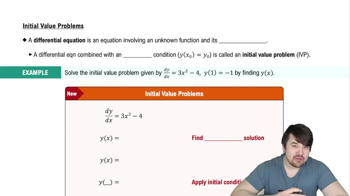
Initial Value Problem (IVP)

An initial value problem involves a differential equation along with a specified value of the unknown function at a starting point. Here, B'(t) = 0.03B - 600 with B(0) = 40,000 means the rate of change of the loan balance depends on the current balance and payments, starting from $40,000 owed.
Recommended video:
05:03
Initial Value Problems

Solving First-Order Linear Differential Equations

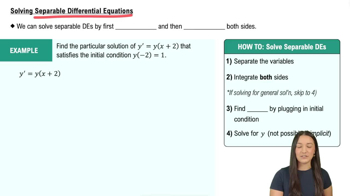
This type of differential equation can be solved using integrating factors or separation of variables. It helps find the function B(t) describing the loan balance over time, which is essential to analyze how the balance changes with interest and payments.
Recommended video:
06:06
Solving Separable Differential Equations

Equilibrium or Steady-State Solution

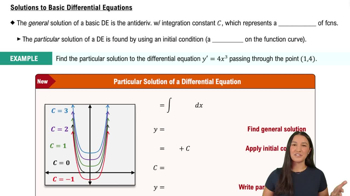
The steady-state solution occurs when the loan balance stops changing, i.e., B'(t) = 0. Finding this equilibrium helps determine the maximum loan amount that can be maintained without increasing debt, by setting the growth from interest equal to the monthly payment.
Recommended video:
04:00
Solutions to Basic Differential Equations
Related Practice
Textbook Question

{Use of Tech} Intravenous drug dosing The amount of drug in the blood of a patient (in milligrams) administered via an intravenous line is governed by the initial value problem y’(t) = -0.02y + 3, y(0) = 0 where t is measured in hours.


b. What is the steady-state level of the drug?

1
views
Textbook Question

Explain why or why not Determine whether the following statements are true and give an explanation or counterexample


b. If k>0 and b>0 then y(t)=0 is never a solution of y'(t)=ky−b.

1
views
Textbook Question

52-56. In this section, several models are presented and the solution of the associated differential equation is given. Later in the chapter, we present methods for solving these differential equations.


{Use of Tech} Drug infusion The delivery of a drug (such as an antibiotic) through an intravenous line may be modeled by the differential equation m'(t) + km(t) = I, where m(t) is the mass of the drug in the blood at time t ≥ 0, k is a constant that describes the rate at which the drug is absorbed, and I is the infusion rate.


b. Graph the solution for I = 10 mg/hr and k = 0.05 hr⁻¹.

Textbook Question

{Use of Tech} Chemical rate equations Let y(t) be t he concentration of a substance in a chemical reaction (typical units are moles/liter). The change in the concentration, under appropriate conditions, is modeled by the equation dy/dt=-ky^n for t≥0, where k>0 is a rate constant and the positive integer n is the order of the reaction.

b. Solve the initial value problem for a second-order reaction (n=2) assuming y(0)=y0.

1
views
Textbook Question

Convergence of Euler's method Suppose Euler's method is applied to the initial value problem y′(t) = ay, y(0) = 1, which has the exact solution y(t) = eᵃᵗ. For this exercise, let h denote the time step (rather than Δt). The grid points are then given by tₖ = kh. We let uₖ be the Euler approximation to the exact solution y(tₖ), for k = 0, 1, 2, ...

b. Show by substitution that uₖ = (1 + ah)ᵏ is a solution of the equations in part (a), for k = 0, 1, 2, ...

Textbook Question

{Use of Tech} Torricelli’s law An open cylindrical tank initially filled with water drains through a hole in the bottom of the tank according to Torricelli’s law (see figure). If h(t) is the depth of water in the tank for t≥0 s, then Torricelli’s law implies h′(t)=−k√h, where k is a constant that includes g=9.8m/s², the radius of the tank, and the radius of the drain. Assume the initial depth of the water is h(0)=Hm. 

b. Find the solution in k=0.1the case that and H=0.5m. 

1
views