
Textbook Question
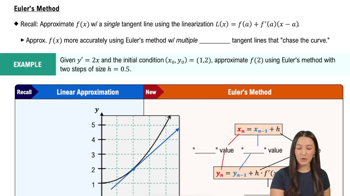
29–32. {Use of Tech} Errors in Euler’s method Consider the following initial value problems.
b. Using the exact solution given, compute the errors in the Euler approximations at t=0.2 and t=0.4.
y′(t) = −y, y(0) = 1; y(t) = e⁻ᵗ

 Verified step by step guidance
 07:39
07:39
 07:33
07:33 06:15
06:1529–32. {Use of Tech} Errors in Euler’s method Consider the following initial value problems.
b. Using the exact solution given, compute the errors in the Euler approximations at t=0.2 and t=0.4.
y′(t) = −y, y(0) = 1; y(t) = e⁻ᵗ
42–43. Implicit solutions for separable equations For the following separable equations, carry out the indicated analysis.
b. Find the value of the arbitrary constant associated with each initial condition. (Each initial condition requires a different constant.)
y'(t) = t²/(y² + 1); y(−1) = 1, y(0) = 0, y(−1) = −1
{Use of Tech} Intravenous drug dosing The amount of drug in the blood of a patient (in milligrams) administered via an intravenous line is governed by the initial value problem y’(t) = -0.02y + 3, y(0) = 0 where t is measured in hours.
b. What is the steady-state level of the drug?
A bad loan Consider a loan repayment plan described by the initial value problem
B'(t)=0.03B−600,B(0)=40,000,
where the amount borrowed is B(0)=\$40,000, the monthly payments are \$600, and B(t) is the unpaid balance in the loan.
b. What is the most that you can borrow under the terms of this loan without going further into debt each month?
{Use of Tech} Chemical rate equations Let y(t) be t he concentration of a substance in a chemical reaction (typical units are moles/liter). The change in the concentration, under appropriate conditions, is modeled by the equation dy/dt=-ky^n for t≥0, where k>0 is a rate constant and the positive integer n is the order of the reaction.
b. Solve the initial value problem for a second-order reaction (n=2) assuming y(0)=y0.
{Use of Tech} Torricelli’s law An open cylindrical tank initially filled with water drains through a hole in the bottom of the tank according to Torricelli’s law (see figure). If h(t) is the depth of water in the tank for t≥0 s, then Torricelli’s law implies h′(t)=−k√h, where k is a constant that includes g=9.8m/s², the radius of the tank, and the radius of the drain. Assume the initial depth of the water is h(0)=Hm.
b. Find the solution in k=0.1the case that and H=0.5m.