
Textbook Question
17–32. Solving initial value problems Determine whether the following equations are separable. If so, solve the initial value problem.
y'(t) = y³sin t, y(0) = 1

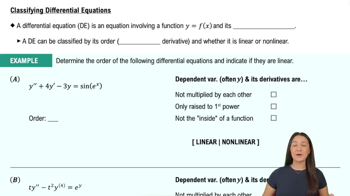
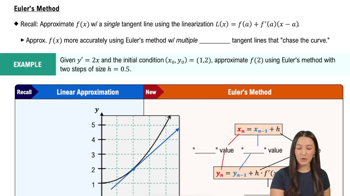
 Verified step by step guidance
 07:39
07:39
 07:33
07:33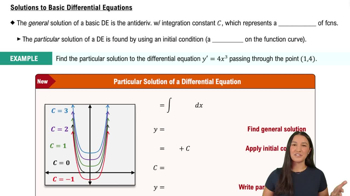 04:00
04:0017–32. Solving initial value problems Determine whether the following equations are separable. If so, solve the initial value problem.
y'(t) = y³sin t, y(0) = 1
The general solution of a first-order linear differential equation is y(t) = Ce⁻¹⁰ᵗ − 13. What solution satisfies the initial condition y(0) = 4?
21–24. Logistic equations Consider the following logistic equations. In each case, sketch the direction field, draw the solution curve for each initial condition, and find the equilibrium solutions. A detailed direction field is not needed. Assume t ≥ 0 and tP ≥ 0.
P′(t) = 0.05P(1−P/800); P(0) = 100, P(0) = 400, P(0) = 700
45–48. General first-order linear equations Consider the general first-order linear equation y'(t)+a(t)y(t)=f(t). This equation can be solved, in principle, by defining the integrating factor p(t)=exp(∫a(t)dt). Here is how the integrating factor works. Multiply both sides of the equation by p (which is always positive) and show that the left side becomes an exact derivative. Therefore, the equation becomes
p(t)(y′(t) + a(t)y(t)) = d/dt(p(t)y(t)) = p(t)f(t).
Now integrate both sides of the equation with respect to t to obtain the solution. Use this method to solve the following initial value problems. Begin by computing the required integrating factor.
y′(t) + (2t)/(t² + 1)y(t) = 1 + 3t², y(1) = 4
12–16. Sketching direction fields Use the window [-2, 2] x [-2, 2] to sketch a direction field for the following equations. Then sketch the solution curve that corresponds to the given initial condition. A detailed direction field is not needed.
y'(t) = 4−y, y(0) = −1
33–42. Solving initial value problems Solve the following initial value problems.
y'(x) = 4 sec² 2x, y(0) = 8