Ch. 9 - Differential Equations
Briggs - Calculus: Early Transcendentals 3rd Edition
Briggs3rd EditionCalculus: Early TranscendentalsISBN: 9780136847243Not the one you use?Change textbook
Chapter 9, Problem 9.1.36

33–42. Solving initial value problems Solve the following initial value problems.
y'(x) = 4 sec² 2x, y(0) = 8

Verified step by step guidance
1
Identify the given differential equation and initial condition: \(y'(x) = 4 \sec^{2}(2x)\) with \(y(0) = 8\).
Recall that to solve the initial value problem, we need to find the antiderivative (integral) of \(y'(x)\) to get \(y(x)\).
Set up the integral: \(y(x) = \int 4 \sec^{2}(2x) \, dx + C\), where \(C\) is the constant of integration.
Use a substitution to integrate: let \(u = 2x\), so \(du = 2 \, dx\) or \(dx = \frac{du}{2}\). Rewrite the integral in terms of \(u\).
Integrate \(4 \sec^{2}(2x) \, dx\) using the substitution, then apply the initial condition \(y(0) = 8\) to solve for \(C\).

Verified video answer for a similar problem:

This video solution was recommended by our tutors as helpful for the problem above.
Video duration:
2m
Was this helpful?

Key Concepts

Here are the essential concepts you must grasp in order to answer the question correctly.

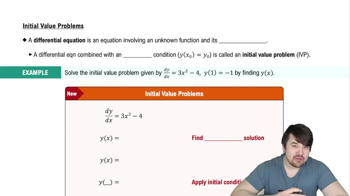
Initial Value Problems (IVPs)

An initial value problem involves a differential equation along with a specified value of the unknown function at a particular point. Solving an IVP means finding a function that satisfies both the differential equation and the initial condition, ensuring a unique solution.
Recommended video:
05:03
Initial Value Problems

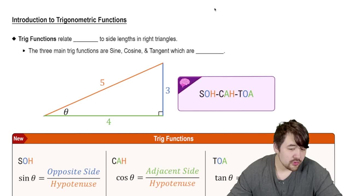
Integration of Trigonometric Functions

Solving the given differential equation requires integrating the derivative function, which involves trigonometric functions like sec²(2x). Recognizing that the integral of sec²(u) du is tan(u) is essential, along with applying substitution when the argument is a function of x.
Recommended video:
6:04
Introduction to Trigonometric Functions

Applying Initial Conditions to Determine Constants

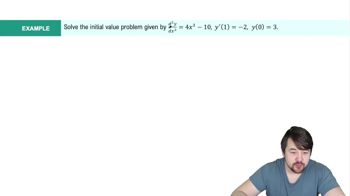
After integrating, the solution includes an arbitrary constant. Using the initial condition y(0) = 8 allows us to substitute x = 0 and y = 8 into the general solution to solve for this constant, yielding the particular solution to the IVP.
Recommended video:
06:46
Initial Value Problems Example 1