
Textbook Question
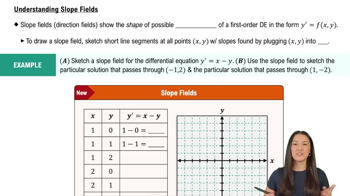
25–28. Two steps of Euler’s method For the following initial value problems, compute the first two approximations u1 and u2 given by Euler’s method using the given time step.
y′(t) = 2−y, y(0) = 1; Δt = 0.1
1
views

 Verified step by step guidance
 05:45
05:45
 07:39
07:39 05:03
05:0325–28. Two steps of Euler’s method For the following initial value problems, compute the first two approximations u1 and u2 given by Euler’s method using the given time step.
y′(t) = 2−y, y(0) = 1; Δt = 0.1
21–24. Logistic equations Consider the following logistic equations. In each case, sketch the direction field, draw the solution curve for each initial condition, and find the equilibrium solutions. A detailed direction field is not needed. Assume t ≥ 0 and tP ≥ 0.
P′(t) = 0.05P(1−P/800); P(0) = 100, P(0) = 400, P(0) = 700
45–48. General first-order linear equations Consider the general first-order linear equation y'(t)+a(t)y(t)=f(t). This equation can be solved, in principle, by defining the integrating factor p(t)=exp(∫a(t)dt). Here is how the integrating factor works. Multiply both sides of the equation by p (which is always positive) and show that the left side becomes an exact derivative. Therefore, the equation becomes
p(t)(y′(t) + a(t)y(t)) = d/dt(p(t)y(t)) = p(t)f(t).
Now integrate both sides of the equation with respect to t to obtain the solution. Use this method to solve the following initial value problems. Begin by computing the required integrating factor.
y′(t) + (2t)/(t² + 1)y(t) = 1 + 3t², y(1) = 4
21–32. Finding general solutions Find the general solution of each differential equation. Use C,C1,C2... to denote arbitrary constants.
y'(t) = t lnt + 1
5–16. Solving separable equations Find the general solution of the following equations. Express the solution explicitly as a function of the independent variable.
u'(x) = e²ˣ⁻ᵘ
33–42. Solving initial value problems Solve the following initial value problems.
y'(x) = 4 sec² 2x, y(0) = 8