Ch. 9 - Differential Equations
Briggs - Calculus: Early Transcendentals 3rd Edition
Briggs3rd EditionCalculus: Early TranscendentalsISBN: 9780136847243Not the one you use?Change textbook
Chapter 9, Problem 9.3.15

5–16. Solving separable equations Find the general solution of the following equations. Express the solution explicitly as a function of the independent variable.
u'(x) = e²ˣ⁻ᵘ

Verified step by step guidance
1
Rewrite the given differential equation \(u'(x) = e^{2x - u}\) in a form that separates the variables \(u\) and \(x\). This means expressing it as \(\frac{du}{dx} = e^{2x} \cdot e^{-u}\), which can be rearranged to isolate \(u\) terms on one side and \(x\) terms on the other.
Separate the variables by multiplying both sides by \(e^{u}\) and \(dx\), giving \(e^{u} du = e^{2x} dx\). This sets up the equation so that all \(u\) terms are on the left and all \(x\) terms are on the right.
Integrate both sides: compute \(\int e^{u} du\) on the left and \(\int e^{2x} dx\) on the right. Remember to include the constant of integration after integrating.
After integration, you will have an implicit equation involving \(u\) and \(x\). Solve this equation algebraically to express \(u\) explicitly as a function of \(x\).
Finally, write the general solution \(u(x)\) including the constant of integration, which represents the family of solutions to the differential equation.

Verified video answer for a similar problem:

This video solution was recommended by our tutors as helpful for the problem above.
Video duration:
1m
Was this helpful?

Key Concepts

Here are the essential concepts you must grasp in order to answer the question correctly.

Separable Differential Equations

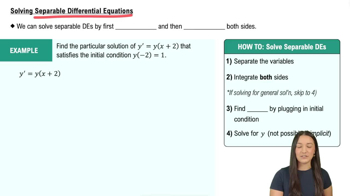
A separable differential equation can be written as a product of a function of the dependent variable and a function of the independent variable. This allows the variables to be separated on opposite sides of the equation, enabling integration with respect to each variable independently.
Recommended video:
06:06
Solving Separable Differential Equations

Integration of Exponential Functions

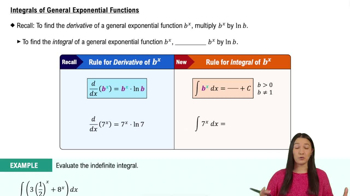
Integrating exponential functions involves recognizing the form e^(ax + b) and applying the rule ∫e^(ax + b) dx = (1/a)e^(ax + b) + C. This is essential when solving differential equations where the right-hand side contains exponential expressions.
Recommended video:
05:11
Integrals of General Exponential Functions

Expressing the Solution Explicitly

After integrating, the solution often involves an implicit relation between variables. Expressing the solution explicitly means solving for the dependent variable as a function of the independent variable, which may require algebraic manipulation or applying inverse functions.
Recommended video:
6:36
Simplifying Trig Expressions
Related Practice
Textbook Question

25–28. Two steps of Euler’s method For the following initial value problems, compute the first two approximations u1 and u2 given by Euler’s method using the given time step.


y′(t) = 2−y, y(0) = 1; Δt = 0.1

1
views

Textbook Question

12–16. Sketching direction fields Use the window [-2, 2] x [-2, 2] to sketch a direction field for the following equations. Then sketch the solution curve that corresponds to the given initial condition. A detailed direction field is not needed.

y(x) = sin y, y(−2) = 1/2

Textbook Question

39–42. Special equations A special class of first-order linear equations have the form a(t)y'(t)+a'(t)y(t)=f(t), where a and f are given functions of t. Notice that the left side of this equation can be written as the derivative of a product, so the equation has the form

a(t)y'(t) + a'(t)y(t) = d/dt (a(t)y(t)) = f(t). 

Therefore, the equation can be solved by integrating both sides with respect to t. Use this idea to solve the following initial value problems. 


(t² + 1)y′(t) + 2ty = 3t², y(2) = 8

Textbook Question

23–26. Loan problems The following initial value problems model the payoff of a loan. In each case, solve the initial value problem, for t≥0 graph the solution, and determine the first month in which the loan balance is zero.


B′(t) = 0.004B − 800, B(0) = 40,000

Textbook Question

Does the function y(t) = 2t satisfy the differential equation y'''(t) + y'(t) = 2?

Textbook Question

45–48. General first-order linear equations Consider the general first-order linear equation y'(t)+a(t)y(t)=f(t). This equation can be solved, in principle, by defining the integrating factor p(t)=exp(∫a(t)dt). Here is how the integrating factor works. Multiply both sides of the equation by p (which is always positive) and show that the left side becomes an exact derivative. Therefore, the equation becomes


p(t)(y′(t) + a(t)y(t)) = d/dt(p(t)y(t)) = p(t)f(t).


Now integrate both sides of the equation with respect to t to obtain the solution. Use this method to solve the following initial value problems. Begin by computing the required integrating factor.


y′(t) + (2t)/(t² + 1)y(t) = 1 + 3t², y(1) = 4

1
views