Ch. 9 - Differential Equations
Briggs - Calculus: Early Transcendentals 3rd Edition
Briggs3rd EditionCalculus: Early TranscendentalsISBN: 9780136847243Not the one you use?Change textbook
Chapter 9, Problem 9.3.30

17–32. Solving initial value problems Determine whether the following equations are separable. If so, solve the initial value problem.
y'(t) = y³sin t, y(0) = 1

Verified step by step guidance
1
Identify whether the differential equation is separable. The given equation is \(y'(t) = y^{3} \sin t\). Since the right side can be expressed as a product of a function of \(y\) and a function of \(t\), it is separable.
Rewrite the differential equation using Leibniz notation: \(\frac{dy}{dt} = y^{3} \sin t\). Then separate variables by dividing both sides by \(y^{3}\) and multiplying both sides by \(dt\): \(\frac{1}{y^{3}} dy = \sin t \, dt\).
Integrate both sides: \(\int \frac{1}{y^{3}} dy = \int \sin t \, dt\). This will give you two antiderivatives, one in terms of \(y\) and one in terms of \(t\), plus a constant of integration.
Solve the integrals: Recall that \(\int y^{-3} dy = \int y^{-3} dy\) and \(\int \sin t \, dt = -\cos t + C\). Write the integrated form explicitly, including the constant of integration on one side.
Apply the initial condition \(y(0) = 1\) to find the constant of integration. Substitute \(t=0\) and \(y=1\) into the integrated equation and solve for the constant. Then express \(y\) explicitly as a function of \(t\) if possible.

Verified video answer for a similar problem:

This video solution was recommended by our tutors as helpful for the problem above.
Video duration:
5m
Was this helpful?

Key Concepts

Here are the essential concepts you must grasp in order to answer the question correctly.

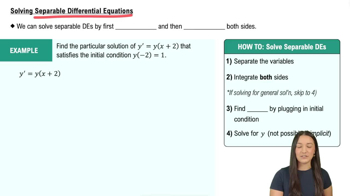
Separable Differential Equations

A differential equation is separable if it can be written as a product of a function of y and a function of t, allowing the variables to be separated on opposite sides of the equation. This form enables integration with respect to each variable independently, simplifying the solution process.
Recommended video:
06:06
Solving Separable Differential Equations

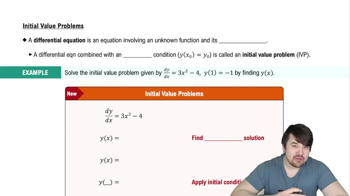
Initial Value Problems (IVP)

An initial value problem specifies the value of the unknown function at a particular point, providing a unique solution to a differential equation. Solving an IVP involves finding the general solution and then applying the initial condition to determine the constant of integration.
Recommended video:
05:03
Initial Value Problems

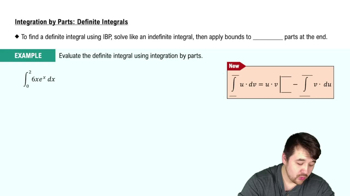
Integration Techniques for Solving ODEs

Once variables are separated, integration is used to solve the resulting expressions. This often involves integrating standard functions like powers of y and trigonometric functions of t. Proper integration and algebraic manipulation yield the explicit or implicit solution to the differential equation.
Recommended video:
06:18
Integration by Parts for Definite Integrals