Ch. 8 - Integration Techniques
Briggs - Calculus: Early Transcendentals 3rd Edition
Briggs3rd EditionCalculus: Early TranscendentalsISBN: 9780136847243Not the one you use?Change textbook
Chapter 8, Problem 8.7.8

7–40. Table look-up integrals Use a table of integrals to evaluate the following indefinite integrals. Some of the integrals require preliminary work, such as completing the square or changing variables, before they can be found in a table.
8. ∫ sin 3x cos 2x dx

Verified step by step guidance
1
Step 1: Recognize that the integral ∫ sin(3x) cos(2x) dx involves the product of sine and cosine functions. To simplify, use the trigonometric identity: sin(A)cos(B) = 1/2 [sin(A+B) + sin(A−B)].
Step 2: Apply the identity to rewrite the integral: ∫ sin(3x)cos(2x) dx = 1/2 ∫ [sin(3x+2x) + sin(3x−2x)] dx.
Step 3: Simplify the arguments of the sine functions: 3x + 2x = 5x and 3x − 2x = x. The integral becomes: 1/2 ∫ [sin(5x) + sin(x)] dx.
Step 4: Split the integral into two separate integrals: 1/2 [∫ sin(5x) dx + ∫ sin(x) dx].
Step 5: Use a table of integrals to find the antiderivatives of sin(5x) and sin(x). For sin(kx), the antiderivative is −(1/k)cos(kx) + C. Apply this formula to both terms and combine the results.

Verified video answer for a similar problem:

This video solution was recommended by our tutors as helpful for the problem above.
Video duration:
3m
Was this helpful?

Key Concepts

Here are the essential concepts you must grasp in order to answer the question correctly.

Trigonometric Identities

Trigonometric identities are equations involving trigonometric functions that are true for all values of the variables. For example, the product-to-sum identities can be used to simplify products of sine and cosine functions, such as sin(3x)cos(2x), into a sum of sine or cosine functions, making integration easier.
Recommended video:
7:17
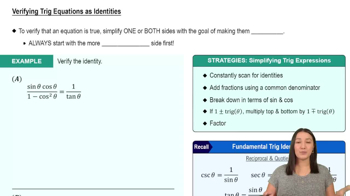
Verifying Trig Equations as Identities

Integration Techniques

Integration techniques are methods used to evaluate integrals that may not be straightforward. Common techniques include substitution, integration by parts, and using tables of integrals. In this case, recognizing the need to simplify the integral before applying a table is crucial for finding the solution.
Recommended video:
06:18
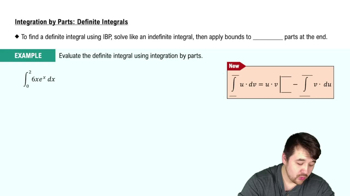
Integration by Parts for Definite Integrals

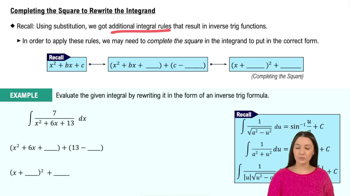
Completing the Square

Completing the square is a method used to transform a quadratic expression into a perfect square trinomial. This technique is often necessary when dealing with integrals involving quadratic expressions in the integrand, as it can simplify the integral and make it easier to evaluate using standard integral tables.
Recommended video:
05:22
Completing the Square to Rewrite the Integrand