Ch. 8 - Integration Techniques
Briggs - Calculus: Early Transcendentals 3rd Edition
Briggs3rd EditionCalculus: Early TranscendentalsISBN: 9780136847243Not the one you use?Change textbook
Chapter 8, Problem 8.2.72

72. Between the sine and inverse sine Find the area of the region bound by the curves y = sin x and y = sin⁻¹x on the interval [0, 1/2].

Verified step by step guidance
1
Identify the two functions given: \(y = \sin x\) and \(y = \sin^{-1} x\) (also written as \(y = \arcsin x\)). We are interested in the area between these curves on the interval \([0, \frac{1}{2}]\).
Determine which function is on top and which is on the bottom over the interval \([0, \frac{1}{2}]\). Since \(\sin x\) is increasing and \(\arcsin x\) is also increasing but defined differently, evaluate or reason about their values at key points (like \(x=0\) and \(x=\frac{1}{2}\)) to find which curve lies above the other.
Set up the integral expression for the area between the curves. The area \(A\) is given by the integral of the difference of the top function minus the bottom function over the interval \([0, \frac{1}{2}]\): \(A = \int_0^{\frac{1}{2}} \left( \text{top function} - \text{bottom function} \right) \, dx\).
Write the integral explicitly using the functions identified in step 2. For example, if \(\arcsin x\) is on top, then \(A = \int_0^{\frac{1}{2}} \left( \arcsin x - \sin x \right) \, dx\).
Evaluate the integral by integrating each term separately. Recall that the integral of \(\arcsin x\) can be found using integration by parts, and the integral of \(\sin x\) is straightforward. Set up the integration by parts for \(\int \arcsin x \, dx\) and then subtract the integral of \(\sin x\) over the interval.

Verified video answer for a similar problem:

This video solution was recommended by our tutors as helpful for the problem above.
Video duration:
6m
Was this helpful?

Key Concepts

Here are the essential concepts you must grasp in order to answer the question correctly.

Understanding the Functions y = sin x and y = sin⁻¹ x

The function y = sin x is the sine function, which maps an angle x (in radians) to its sine value. The inverse sine function y = sin⁻¹ x (or arcsin x) returns the angle whose sine is x. On the interval [0, 1/2], sin x is increasing and arcsin x maps values from [0, 1/2] back to angles in [0, π/6]. Understanding their behavior and ranges is essential for setting up the problem.
Recommended video:
03:39
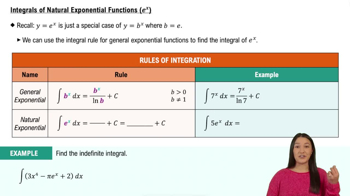
Integrals of Natural Exponential Functions (e^x)

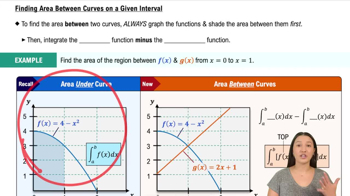
Finding the Area Between Two Curves

The area between two curves y = f(x) and y = g(x) over an interval [a, b] is found by integrating the difference |f(x) - g(x)| dx. Identifying which function is on top in the interval is crucial to set up the integral correctly. This concept allows calculation of the bounded region's area between y = sin x and y = sin⁻¹ x.
Recommended video:
05:23
Finding Area Between Curves on a Given Interval

Integration Techniques and Limits

Evaluating the definite integral to find the area requires knowledge of integration techniques, including integrating trigonometric and inverse trigonometric functions. Properly applying limits of integration from 0 to 1/2 and handling the integral of arcsin x and sin x ensures accurate computation of the bounded area.
Recommended video:
05:50
One-Sided Limits