Ch. 8 - Integration Techniques
Briggs - Calculus: Early Transcendentals 3rd Edition
Briggs3rd EditionCalculus: Early TranscendentalsISBN: 9780136847243Not the one you use?Change textbook
Chapter 8, Problem 8.7.46

41–48. Geometry problems Use a table of integrals to solve the following problems.
46. Find the area of the region bounded by the graph of y = 1/√(x² - 2x + 2) and the x-axis from x = 0 to x = 3.

Verified step by step guidance
1
Step 1: Recognize that the problem involves finding the area under the curve y = 1/√(x² - 2x + 2) from x = 0 to x = 3. This requires evaluating the definite integral of the function over the given interval.
Step 2: Simplify the quadratic expression x² - 2x + 2 in the denominator. Complete the square to rewrite it as (x - 1)² + 1. This step helps identify the structure of the integrand and makes it easier to match with a formula from the table of integrals.
Step 3: Refer to a table of integrals to find a formula that matches the form of the integrand. The expression 1/√((x - a)² + b²) corresponds to an arctangent integral formula: ∫ dx / √((x - a)² + b²) = (1/√b) * arctan((x - a)/√b) + C.
Step 4: Apply the formula to the given integral. Here, a = 1 and b² = 1, so √b = 1. Substitute these values into the formula to express the antiderivative of the function.
Step 5: Evaluate the definite integral by substituting the limits of integration (x = 0 and x = 3) into the antiderivative. Compute the difference between the values of the antiderivative at the upper and lower limits to find the area.

Verified video answer for a similar problem:

This video solution was recommended by our tutors as helpful for the problem above.
Video duration:
4m

Key Concepts

Here are the essential concepts you must grasp in order to answer the question correctly.

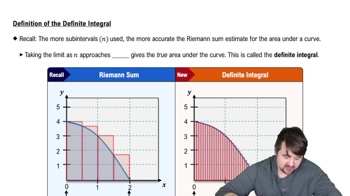
Definite Integrals

Definite integrals are used to calculate the area under a curve between two specified limits. In this problem, the area under the curve defined by the function y = 1/√(x² - 2x + 2) from x = 0 to x = 3 can be found by evaluating the definite integral of the function over that interval.
Recommended video:
Guided course
05:43
Definition of the Definite Integral

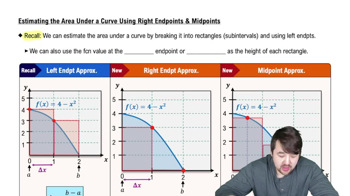
Area Under a Curve

The area under a curve represents the integral of a function over a given interval. This area can be interpreted as the accumulation of values of the function, which in this case corresponds to the area between the curve and the x-axis from x = 0 to x = 3.
Recommended video:
Guided course
05:59
Estimating the Area Under a Curve with Right Endpoints & Midpoint

Integral Tables

Integral tables are reference tools that provide a list of integrals and their solutions, which can simplify the process of finding areas or solving integrals. In this problem, using a table of integrals can help quickly identify the antiderivative of the function y = 1/√(x² - 2x + 2) needed to compute the definite integral.
Recommended video:
Guided course
08:09
Tabular Integration by Parts