
Ch. 8 - Integration Techniques
Briggs - Calculus: Early Transcendentals 3rd Edition
Briggs3rd EditionCalculus: Early TranscendentalsISBN: 9780136847243Not the one you use?Change textbook
Chapter 8, Problem 8.2.49c

49. Explain why or why not Determine whether the following statements are true and give an explanation or counterexample:
c. ∫ v du = u·v - ∫ u dv

Verified step by step guidance
1
Recognize that the given statement \( \int v \, du = u \cdot v - \int u \, dv \) resembles the integration by parts formula, which is usually written as \( \int u \, dv = u \cdot v - \int v \, du \).
Recall the integration by parts formula: \( \int u \, dv = u \cdot v - \int v \, du \). This formula is derived from the product rule for differentiation.
Compare the given statement with the standard formula. Notice that the roles of \( u \) and \( v \) are swapped in the integrals and products.
To verify if the statement is true, try substituting \( u \) and \( v \) in the standard formula and see if it matches the given expression or if it leads to a contradiction.
Conclude whether the statement is true or false based on the comparison and substitution, and provide a counterexample if it is false by choosing specific functions \( u(x) \) and \( v(x) \) to test the equality.

Verified video answer for a similar problem:

This video solution was recommended by our tutors as helpful for the problem above.
Video duration:
1m

Key Concepts

Here are the essential concepts you must grasp in order to answer the question correctly.

Integration by Parts Formula

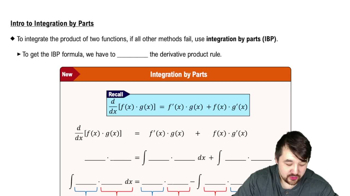
Integration by parts is a technique derived from the product rule of differentiation. It states that ∫ u dv = u·v - ∫ v du, where u and v are functions of a variable. This formula helps transform complex integrals into simpler ones by choosing appropriate u and dv.
Recommended video:
Guided course
08:30
Introduction to Integration by Parts

Differentiation and Notation Consistency

In integration by parts, the differentials du and dv correspond to derivatives of u and v respectively. The formula requires careful attention to the order of terms; swapping du and dv changes the meaning and validity of the expression. Correct notation ensures the formula is applied properly.
Recommended video:
Guided course
04:22
Sigma Notation

Counterexamples and Verification

To determine if a statement like ∫ v du = u·v - ∫ u dv is true, one can test it with specific functions u and v. If the equality fails for any example, it is false. This approach helps verify or refute integral identities by direct substitution and evaluation.
Related Practice
Textbook Question

109. Escape velocity and black holes The work required to launch an object from the surface of Earth to outer space is given by W = ∫ from R to ∞ of F(x) dx, where R = 6370 km is the approximate radius of Earth, F(x) = (GMm)/x² is the gravitational force between Earth and the object, G is the gravitational constant, M is the mass of Earth, m is the mass of the object, and GM = 4 × 10¹⁴ m³/s².

c. The French scientist Laplace anticipated the existence of black holes in the 18th century with the following argument: If a body has an escape velocity that equals or exceeds the speed of light, c = 300,000 km/s, then light cannot escape the body and it cannot be seen. Show that such a body has a radius R ≤ 2GM/c². For Earth to be a black hole, what would its radius need to be?

1
views
Textbook Question

2. Give an example of each of the following.

b. A repeated linear factor

Textbook Question

45–48. {Use of Tech} Trapezoid Rule and Simpson’s Rule Consider the following integrals and the given values of n.

45. ∫(0 to 1) e^(2x) dx; n = 25

c. Compute the absolute errors in the Trapezoid Rule and Simpson’s Rule with 2n subintervals.

Textbook Question

60. Two Methods

c. Verify that your answers to parts (a) and (b) are consistent.

Textbook Question

59. Two Methods

b. Evaluate ∫(x / √(x + 1)) dx using substitution.

1
views
Textbook Question

75. {Use of Tech} Oscillator displacements Suppose a mass on a spring that is slowed by friction has the position function:

s(t) = e⁻ᵗ sin t

c. Generalize part (b) and find the average value of the position on the interval [nπ, (n+1)π], for n = 0, 1, 2, ...