
Textbook Question
49. Explain why or why not Determine whether the following statements are true and give an explanation or counterexample:
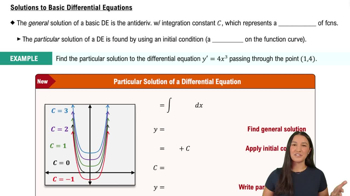
c. ∫ v du = u·v - ∫ u dv
1
views

 Verified step by step guidance
 04:00
04:00
 07:33
07:33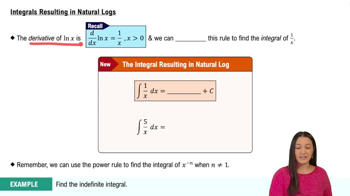 03:48
03:4849. Explain why or why not Determine whether the following statements are true and give an explanation or counterexample:
c. ∫ v du = u·v - ∫ u dv
45–48. {Use of Tech} Trapezoid Rule and Simpson’s Rule Consider the following integrals and the given values of n.
46. ∫(0 to 2) x⁴ dx; n = 30
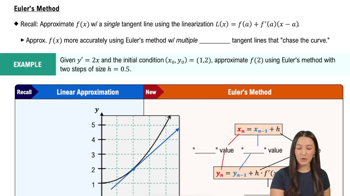
c. Compute the absolute errors in the Trapezoid Rule and Simpson’s Rule with 2n subintervals.
109. Escape velocity and black holes The work required to launch an object from the surface of Earth to outer space is given by W = ∫ from R to ∞ of F(x) dx, where R = 6370 km is the approximate radius of Earth, F(x) = (GMm)/x² is the gravitational force between Earth and the object, G is the gravitational constant, M is the mass of Earth, m is the mass of the object, and GM = 4 × 10¹⁴ m³/s².
c. The French scientist Laplace anticipated the existence of black holes in the 18th century with the following argument: If a body has an escape velocity that equals or exceeds the speed of light, c = 300,000 km/s, then light cannot escape the body and it cannot be seen. Show that such a body has a radius R ≤ 2GM/c². For Earth to be a black hole, what would its radius need to be?
45–48. {Use of Tech} Trapezoid Rule and Simpson’s Rule Consider the following integrals and the given values of n.
45. ∫(0 to 1) e^(2x) dx; n = 25
c. Compute the absolute errors in the Trapezoid Rule and Simpson’s Rule with 2n subintervals.
59. Two Methods
b. Evaluate ∫(x / √(x + 1)) dx using substitution.
75. {Use of Tech} Oscillator displacements Suppose a mass on a spring that is slowed by friction has the position function:
s(t) = e⁻ᵗ sin t
c. Generalize part (b) and find the average value of the position on the interval [nπ, (n+1)π], for n = 0, 1, 2, ...