Back
Back
Problem 7.1.30
29–62. Integrals Evaluate the following integrals. Include absolute values only when needed.
∫ (x²) / (4x³ + 7) dx
Problem 7.2.49
Compounded inflation The U.S. government reports the rate of inflation (as measured by the consumer index) both monthly and annually. Suppose for a particular month, the monthly rate of inflation is reported as 0.8%. Assuming this rate remains constant, what is the corresponding annual rate of inflation? Is the annual rate 12 times the monthly rate? Explain.
Problem 7.3.100
Surface area of a catenoid When the catenary y = a cosh x/a is revolved about the x-axis, it sweeps out a surface of revolution called a catenoid. Find the area of the surface generated when y = cosh x on [–ln 2, ln 2] is rotated about the x-axis.
Problem 7.3.34
22–36. Derivatives Find the derivatives of the following functions.
f(x) = csch⁻¹(2/x)
Problem 7.1.64
63–66. Calculator limits Use a calculator to make a table similar to Table 7.1 to approximate the following limits. Confirm your result with l’Hôpital’s Rule.
limₕ→₀ (1 + 3h)^{2/h}
Problem 7.1.33
29–62. Integrals Evaluate the following integrals. Include absolute values only when needed.
∫ e^{2x} / (4 + e^{2x}) dx
Problem 7.1.78
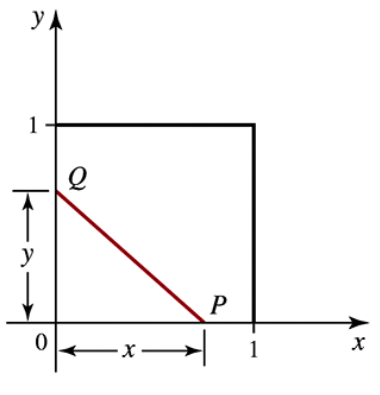
Probability as an integral Two points P and Q are chosen randomly, one on each of two adjacent sides of a unit square (see figure). What is the probability that the area of the triangle formed by the sides of the square and the line segment PQ is less than one-fourth the area of the square? Begin by showing that x and y must satisfy xy < 1/2 in order for the area condition to be met. Then argue that the required probability is: 1/2 + ∫[1/2 to 1] (dx / 2x) and evaluate the integral.
Problem 7.1.25
Evaluate the following derivatives.
d/dx ((1/x)ˣ)
Problem 7.1.10
7–28. Derivatives Evaluate the following derivatives.
d/dx (ln (cos² x))
Problem 7.3.5
Express sinh⁻¹ x in terms of logarithms.
Problem 7.3.12
11–15. Identities Prove each identity using the definitions of the hyperbolic functions.
tanh(−x) = −tanh x
Problem 7.2.52
"General relative growth rates Define the relative growth rate of the function f over the time interval T to be the relative change in f over an interval of length T:
R_T = [f(t + T) − f(t)] / f(t)
Show that for the exponential function y(t) = y₀ e^{kt}, the relative growth rate R_T, for fixed T, is constant for all t."
Problem 7.3.32
22–36. Derivatives Find the derivatives of the following functions.
f(t) = 2 tanh⁻¹ √t
Problem 7.53
37–56. Integrals Evaluate each integral.
∫ (cosh z) / (sinh² z) dz
Problem 7.3.83
Points of inflection Find the x-coordinate of the point(s) of inflection of f(x) = tanh² x.
Problem 7.2.54
Geometric means A quantity grows exponentially according to y(t) = y₀eᵏᵗ. What is the relationship among m, n, and p such that y(p) = √(y(m)y(n))?
Problem 7.2.20
15–20. Designing exponential growth functions Complete the following steps for the given situation.
a. Find the rate constant k and use it to devise an exponential growth function that fits the given data.
b. Answer the accompanying question.
Cell growth The number of cells in a tumor doubles every 6 weeks starting with 8 cells. After how many weeks does the tumor have 1500 cells?
Problem 7.3.85
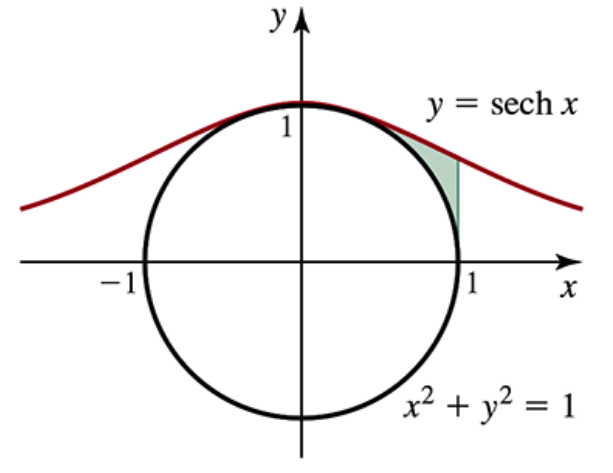
Area of region Find the area of the region bounded by y = sech x, x = 1, and the unit circle (see figure).
Problem 7.3.6
What is the domain of sech⁻¹ x? How is sech⁻¹ x defined in terms of the inverse hyperbolic cosine?
Problem 7.3.49
37–56. Integrals Evaluate each integral.
∫ eˣ/(36 – e²ˣ), x < ln 6
Problem 7.3.44
37–56. Integrals Evaluate each integral.
∫₀⁴ sech²√x / √x dx
Problem 7.3.72
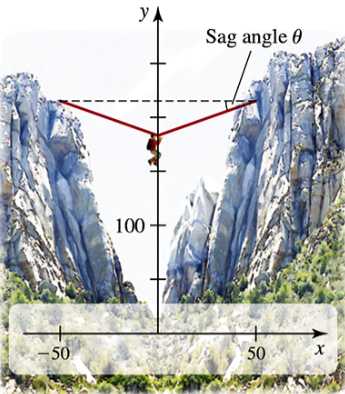
Sag angle Imagine a climber clipping onto the rope described in Example 7 and pulling himself to the rope’s midpoint. Because the rope is supporting the weight of the climber, it no longer takes the shape of the catenary y = 200 cosh x/200. Instead, the rope (nearly) forms two sides of an isosceles triangle. Compute the sag angle θ illustrated in the figure, assuming the rope does not stretch when weighted. Recall from Example 7 that the length of the rope is 101 ft.
Problem 7.1.68
Logarithm properties Use the integral definition of the natural logarithm to prove that ln(x/y) = ln x - ln y.
Problem 7.1.44
29–62. Integrals Evaluate the following integrals. Include absolute values only when needed.
∫₀^{π/2} 4^{sin x} cos x dx
Problem 7.3.65
63–68. Definite integrals Evaluate the following definite integrals. Use Theorem 7.7 to express your answer in terms of logarithms.
∫₋₂² dt/(t² – 9)
Problem 7.3.56
37–56. Integrals Evaluate each integral.
∫₂₅²²⁵ dx / (x² + 25x) (Hint: √(x² + 25x) = √x √(x + 25).)
Problem 7.3.47
37–56. Integrals Evaluate each integral.
∫ dx/(8 – x²), x > 2√2
Problem 7.3.27
22–36. Derivatives Find the derivatives of the following functions.
f(x) = ln sech x
Problem 7.3.25
22–36. Derivatives Find the derivatives of the following functions.
f(x) = tanh²x
Problem 7.3.26
22–36. Derivatives Find the derivatives of the following functions.
f(x) = √coth 3x