Textbook Question
Theorem 7.8
Differentiate sinh⁻¹ x = ln (x + √(x² + 1)) to show that d/dx (sinh⁻¹ x) = 1 / √(x² + 1).

 Briggs 3rd EditionCh. 7 - Logarithmic, Exponential Functions, and Hyperbolic FunctionsProblem 7.2.23b
 Verified step by step guidance
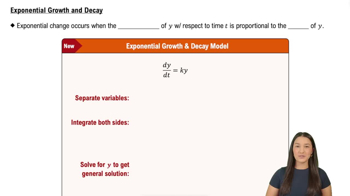
 09:29
09:29
 02:32
02:32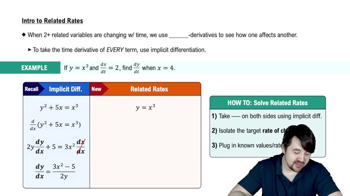 04:16
04:16Theorem 7.8
Differentiate sinh⁻¹ x = ln (x + √(x² + 1)) to show that d/dx (sinh⁻¹ x) = 1 / √(x² + 1).
Overtaking City A has a current population of 500,000 people and grows at a rate of 3%/yr. City B has a current population of 300,000 and grows at a rate of 5%/yr.
b. Suppose City C has a current population of y₀ < 500,000 and a growth rate of p > 3%/yr. What is the relationship between y₀ and p such that Cities A and C have the same population in 10 years?
A running model A model for the startup of a runner in a short race results in the velocity function v(t) = a(1 - e⁻ᵗ/ᶜ), where a and c are positive constants, t is measured in seconds, and v has units of m/s. (Source: Joe Keller, A Theory of Competitive Running, Physics Today, 26, Sep 1973)
b. Using the velocity in part (a) and assuming s(0) = 0, find the position function s(t), for t ≥ 0.
Depreciation of equipment A large die-casting machine used to make automobile engine blocks is purchased for \$2.5 million. For tax purposes, the value of the machine can be depreciated by 6.8% of its current value each year.
b. After how many years is the value of the machine 10% of its original value?
Definitions of hyperbolic sine and cosine Complete the following steps to prove that when the x- and y-coordinates of a point on the hyperbola x² - y² = 1 are defined as cosh t and sinh t, respectively, where t is twice the area of the shaded region in the figure, x and y can be expressed as
x = cosh t = (eᵗ + e⁻ᵗ) / 2 and y = sinh t = (eᵗ - e⁻ᵗ) / 2.
b. In Chapter 8, the formula for the integral in part (a) is derived:
∫ √(z² − 1) dz = (z/2)√(z² − 1) − (1/2) ln|z + √(z² − 1)| + C.
Evaluate this integral on the interval [1, x], explain why the absolute value can be dropped, and combine the result with part (a) to show that:
t = ln(x + √(x² − 1)).
Many formulas There are several ways to express the indefinite integral of sech x.
b. Show that ∫ sech x dx = sin⁻¹ (tanh x) + C. (Hint: Show that sech x = sech² x / √(1 − tanh² x) and then make a change of variables.)