
Ch. 7 - Logarithmic, Exponential Functions, and Hyperbolic Functions
Briggs - Calculus: Early Transcendentals 3rd Edition
Briggs3rd EditionCalculus: Early TranscendentalsISBN: 9780136847243Not the one you use?Change textbook
Chapter 7, Problem 7.3.112b

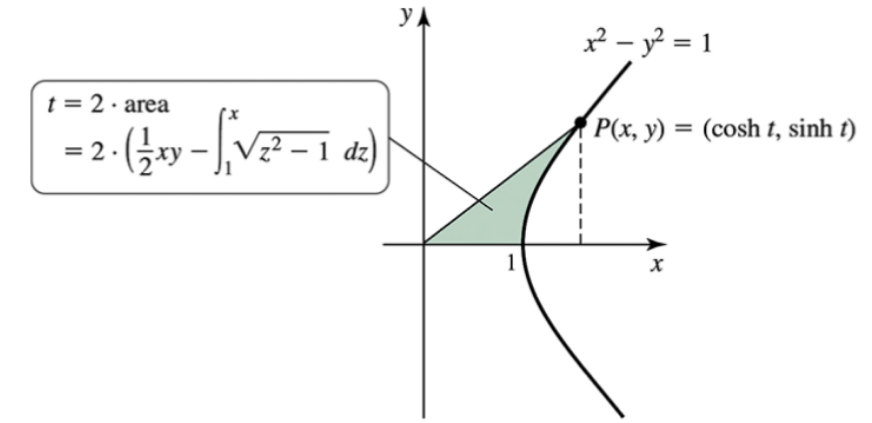
Definitions of hyperbolic sine and cosine Complete the following steps to prove that when the x- and y-coordinates of a point on the hyperbola x² - y² = 1 are defined as cosh t and sinh t, respectively, where t is twice the area of the shaded region in the figure, x and y can be expressed as
x = cosh t = (eᵗ + e⁻ᵗ) / 2 and y = sinh t = (eᵗ - e⁻ᵗ) / 2.


Graph of hyperbola x² - y² = 1 with shaded area and point P(x, y) = (cosh t, sinh t) illustrating t as twice the area.


b. In Chapter 8, the formula for the integral in part (a) is derived:
∫ √(z² − 1) dz = (z/2)√(z² − 1) − (1/2) ln|z + √(z² − 1)| + C.
Evaluate this integral on the interval [1, x], explain why the absolute value can be dropped, and combine the result with part (a) to show that:
t = ln(x + √(x² − 1)).

Verified step by step guidance
1
Start by expressing the parameter \( t \) as twice the shaded area, which is given by the formula: \[ t = 2 \left( \frac{1}{2} x y - \int_1^x \sqrt{z^2 - 1} \, dz \right) \]. This represents the area of the triangle minus the area under the curve from 1 to \( x \).
Recognize that the point \( P(x, y) \) lies on the hyperbola \( x^2 - y^2 = 1 \), and the coordinates are defined as \( x = \cosh t \) and \( y = \sinh t \). This means \( y = \sqrt{x^2 - 1} \) because \( y^2 = x^2 - 1 \).
Use the integral formula provided: \[ \int \sqrt{z^2 - 1} \, dz = \frac{z}{2} \sqrt{z^2 - 1} - \frac{1}{2} \ln|z + \sqrt{z^2 - 1}| + C \]. Evaluate this definite integral from 1 to \( x \) by substituting the limits into the antiderivative.
Explain why the absolute value in the logarithm can be dropped: since \( x \geq 1 \) and \( \sqrt{x^2 - 1} \geq 0 \), the expression inside the logarithm, \( x + \sqrt{x^2 - 1} \), is always positive, so \( |x + \sqrt{x^2 - 1}| = x + \sqrt{x^2 - 1} \).
Combine the evaluated integral with the expression for \( t \) from step 1, simplify the terms, and show that \( t = \ln(x + \sqrt{x^2 - 1}) \). This links the parameter \( t \) to the coordinates on the hyperbola and completes the proof.

Verified video answer for a similar problem:

This video solution was recommended by our tutors as helpful for the problem above.
Video duration:
2m
Was this helpful?

Key Concepts

Here are the essential concepts you must grasp in order to answer the question correctly.

Hyperbolic Functions (sinh and cosh)

Hyperbolic sine (sinh) and cosine (cosh) are analogs of the trigonometric sine and cosine but for a hyperbola. They are defined as sinh t = (e^t - e^(-t))/2 and cosh t = (e^t + e^(-t))/2. These functions satisfy the identity cosh² t - sinh² t = 1, which corresponds to the equation of the hyperbola x² - y² = 1.
Recommended video:
5:50
Asymptotes of Hyperbolas

Area Interpretation and Parametrization of the Hyperbola

The parameter t is defined as twice the area of the shaded region bounded by the hyperbola, the x-axis, and the vertical line at x. This geometric interpretation links the hyperbolic functions to the integral of √(z² - 1), providing a way to parametrize points on the hyperbola as (cosh t, sinh t).
Recommended video:
Guided course
08:02
Parameterizing Equations

Integral of √(z² - 1) and Logarithmic Expression

The integral ∫√(z² - 1) dz evaluates to (z/2)√(z² - 1) - (1/2) ln|z + √(z² - 1)| + C. Evaluating this from 1 to x and dropping the absolute value (since x ≥ 1) leads to the expression t = ln(x + √(x² - 1)), connecting the parameter t to x and thus to cosh t.
Recommended video:
7:30
Logarithms Introduction
Related Practice
Textbook Question

A running model A model for the startup of a runner in a short race results in the velocity function v(t) = a(1 - e⁻ᵗ/ᶜ), where a and c are positive constants, t is measured in seconds, and v has units of m/s. (Source: Joe Keller, A Theory of Competitive Running, Physics Today, 26, Sep 1973)


b. Using the velocity in part (a) and assuming s(0) = 0, find the position function s(t), for t ≥ 0.

Textbook Question

Projection sensitivity

According to the 2014 national population projections published by the U.S. Census Bureau, the U.S. population is projected to be 334.4 million in 2020 with an estimated growth rate of 0.79%/yr.

b. Suppose the actual growth rate is instead 0.7%. What are the resulting doubling time and projected 2050 population?

Textbook Question

Velocity of falling body Refer to Exercise 95, which gives the position function for a falling body. Use m = 75 kg and k = 0.2.


c. How long does it take for the BASE jumper to reach a speed of 45 m/s (roughly 100 mi/hr)?

1
views
Textbook Question

Depreciation of equipment A large die-casting machine used to make automobile engine blocks is purchased for \$2.5 million. For tax purposes, the value of the machine can be depreciated by 6.8% of its current value each year.


b. After how many years is the value of the machine 10% of its original value?

Textbook Question

Many formulas There are several ways to express the indefinite integral of sech x.


b. Show that ∫ sech x dx = sin⁻¹ (tanh x) + C. (Hint: Show that sech x = sech² x / √(1 − tanh² x) and then make a change of variables.)

Textbook Question

Power lines A power line is attached at the same height to two utility poles that are separated by a distance of 100 ft; the power line follows the curve ƒ(x) = a cosh x/a. Use the following steps to find the value of a that produces a sag of 10 ft midway between the poles. Use a coordinate system that places the poles at x = ±50.

c. Use your answer in part (b) to find a, and then compute the length of the power line.