
Ch. 7 - Logarithmic, Exponential Functions, and Hyperbolic Functions
Briggs - Calculus: Early Transcendentals 3rd Edition
Briggs3rd EditionCalculus: Early TranscendentalsISBN: 9780136847243Not the one you use?Change textbook
Chapter 7, Problem 7.3.106b

Theorem 7.8
Differentiate sinh⁻¹ x = ln (x + √(x² + 1)) to show that d/dx (sinh⁻¹ x) = 1 / √(x² + 1).

Verified step by step guidance
1
Start with the given function: \(y = \sinh^{-1} x = \ln \left( x + \sqrt{x^{2} + 1} \right)\).
Differentiate both sides with respect to \(x\) using the chain rule and the derivative of the natural logarithm: \(\frac{dy}{dx} = \frac{1}{x + \sqrt{x^{2} + 1}} \cdot \frac{d}{dx} \left( x + \sqrt{x^{2} + 1} \right)\).
Find the derivative inside the product: \(\frac{d}{dx} \left( x + \sqrt{x^{2} + 1} \right) = 1 + \frac{1}{2 \sqrt{x^{2} + 1}} \cdot 2x = 1 + \frac{x}{\sqrt{x^{2} + 1}}\).
Substitute this back into the expression for \(\frac{dy}{dx}\): \(\frac{dy}{dx} = \frac{1 + \frac{x}{\sqrt{x^{2} + 1}}}{x + \sqrt{x^{2} + 1}}\).
Simplify the expression by combining terms over a common denominator and rationalizing if necessary to show that \(\frac{dy}{dx} = \frac{1}{\sqrt{x^{2} + 1}}\).

Verified video answer for a similar problem:

This video solution was recommended by our tutors as helpful for the problem above.
Video duration:
4m
Was this helpful?

Key Concepts

Here are the essential concepts you must grasp in order to answer the question correctly.

Inverse Hyperbolic Sine Function (sinh⁻¹ x)

The inverse hyperbolic sine function, sinh⁻¹ x, is defined as the value whose hyperbolic sine is x. It can be expressed using logarithms as sinh⁻¹ x = ln(x + √(x² + 1)), which helps in differentiating it using standard calculus techniques.
Recommended video:
4:03
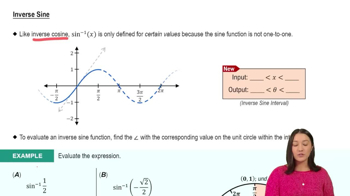
Inverse Sine

Differentiation of Logarithmic Functions

Differentiating a logarithmic function ln(u) involves applying the chain rule: d/dx[ln(u)] = (1/u) * du/dx. This rule is essential for differentiating sinh⁻¹ x when expressed as a logarithm, requiring careful computation of the derivative of the inner function.
Recommended video:
06:30
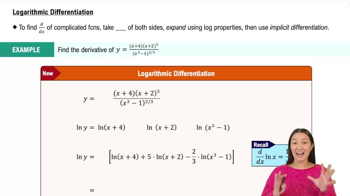
Logarithmic Differentiation

Chain Rule and Derivative of Composite Functions

The chain rule allows differentiation of composite functions by multiplying the derivative of the outer function by the derivative of the inner function. In this problem, it is used to differentiate the expression inside the logarithm, particularly the term x + √(x² + 1).
Recommended video:
03:58
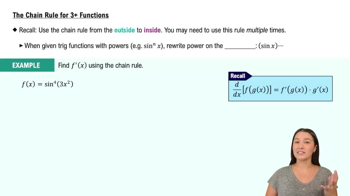
The Chain Rule for 3+ Functions
Related Practice
Textbook Question

Overtaking City A has a current population of 500,000 people and grows at a rate of 3%/yr. City B has a current population of 300,000 and grows at a rate of 5%/yr.

b. Suppose City C has a current population of y₀ < 500,000 and a growth rate of p > 3%/yr. What is the relationship between y₀ and p such that Cities A and C have the same population in 10 years?

Textbook Question

Explain why or why not Determine whether the following statements are true and give an explanation or counterexample. Assume x > 0 and y > 0.


b. ln 0 = 1

Textbook Question

61–62. Points of intersection and area

b. Compute the area of the region described.


f(x) = sinh x, g(x) = tanh x; the region bounded by the graphs of f, g, and x = ln 3

1
views
Textbook Question

A running model A model for the startup of a runner in a short race results in the velocity function v(t) = a(1 - e⁻ᵗ/ᶜ), where a and c are positive constants, t is measured in seconds, and v has units of m/s. (Source: Joe Keller, A Theory of Competitive Running, Physics Today, 26, Sep 1973)


b. Using the velocity in part (a) and assuming s(0) = 0, find the position function s(t), for t ≥ 0.

Textbook Question

Projection sensitivity

According to the 2014 national population projections published by the U.S. Census Bureau, the U.S. population is projected to be 334.4 million in 2020 with an estimated growth rate of 0.79%/yr.

b. Suppose the actual growth rate is instead 0.7%. What are the resulting doubling time and projected 2050 population?

Textbook Question

Depreciation of equipment A large die-casting machine used to make automobile engine blocks is purchased for \$2.5 million. For tax purposes, the value of the machine can be depreciated by 6.8% of its current value each year.


b. After how many years is the value of the machine 10% of its original value?