Back
Back
Problem 6.4.68
64–68. Shell method Use the shell method to find the volume of the following solids.
A hole of radius r≤R is drilled symmetrically along the axis of a bullet. The bullet is formed by revolving the parabola y = 6(1−x²/R²) about the y-axis, where 0≤x≤R.
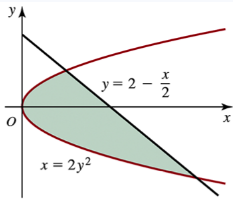
Problem 6.2.25
Determine the area of the shaded region in the following figures.
Problem 6.5.18
9–20. Arc length calculations Find the arc length of the following curves on the given interval.
x = 2e^√2y + 1/16e^−√2y, for 0 ≤ y ≤ ln²/√2
Problem 6.3.4
Why is the disk method a special case of the general slicing method?
Problem 6.7.52
52–54. Force on a window A diving pool that is 4 m deep and full of water has a viewing window on one of its vertical walls. Find the force on the following windows.
The window is a square, 0.5 m on a side, with the lower edge of the window on the bottom of the pool.
Problem 6.4.46
45–48. Shell and washer methods about other lines Use both the shell method and the washer method to find the volume of the solid that is generated when the region in the first quadrant bounded by y = x²,y=1, and x=0 is revolved about the following lines.
x = -1
Problem 6.4.53
53–62. Choose your method Let R be the region bounded by the following curves. Use the method of your choice to find the volume of the solid generated when R is revolved about the given axis.
y = x−x⁴,y=0; about the x-axis.
Problem 6.7.63
Drinking juice A glass has circular cross sections that taper (linearly) from a radius of 5 cm at the top of the glass to a radius of 4 cm at the bottom. The glass is 15 cm high and full of orange juice. How much work is required to drink all the juice through a straw if your mouth is 5 cm above the top of the glass? Assume the density of orange juice equals the density of water.
Problem 6.6.13
Find the area of the surface generated when the given curve is revolved about the given axis.
y=√1−x^2, for −1/2≤x≤1/2; about the x-axis
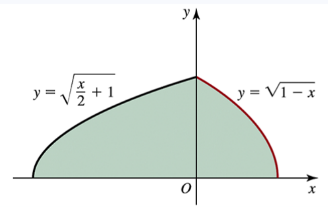
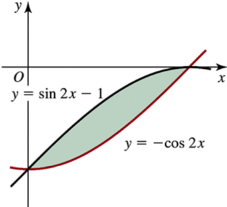
Problem 6.2.21
Determine the area of the shaded region in the following figures.
Problem 6.2.39
Find the area of the region described in the following exercises.
The region bounded by y=e^x, y=e^−2x, and x=ln 4
Problem 6.3.60
The region R is bounded by the graph of f(x)=2x(2−x) and the x-axis. Which is greater, the volume of the solid generated when R is revolved about the line y=2 or the volume of the solid generated when R is revolved about the line y=0? Use integration to justify your answer.
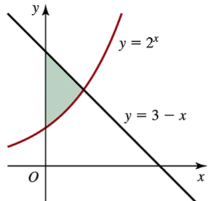
Problem 6.2.13
Determine the area of the shaded region in the following figures.
(Hint: Find the intersection point by inspection.)
Problem 6.6.1
What is the area of the curved surface of a right circular cone of radius 3 and height 4?
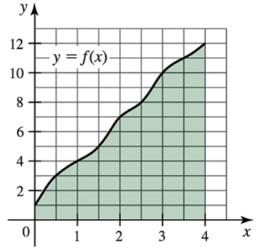
Problem 6.3.67
Suppose the region bounded by the curve y=f(x) from x=0 to x=4 (see figure) is revolved about the x-axis to form a solid of revolution. Use left, right, and midpoint Riemann sums, with n=4 subintervals of equal length, to estimate the volume of the solid of revolution.
Problem 6.5.12
9–20. Arc length calculations Find the arc length of the following curves on the given interval.
y = 3 ln x− x²/24 on [1, 6]
Problem 6.7.18
13–20. Mass of one-dimensional objects Find the mass of the following thin bars with the given density function.
ρ(x) = {1 if 0≤x≤2 {2 if 2<x≤3
Problem 6.5.14
9–20. Arc length calculations Find the arc length of the following curves on the given interval.
y = x^3/2 / 3 − x^1/2 on [4, 16]
Problem 6.2.E.71
Find the area of the following regions, expressing your results in terms of the positive integer n≥2.
Let Aₙ be the area of the region bounded by f(x)=x^1/n and g(x)=x^n on the interval [0,1], where n is a positive integer. Evaluate lim n→∞ Aₙ and interpret the result. br
Problem 6.R.55a
43–55. Volumes of solids Choose the general slicing method, the disk/washer method, or the shell method to answer the following questions.
The region bounded by the graphs of y = 2x,y = 6−x, and y = 0 is revolved about the line y = −2 and the line x = −2. Find the volumes of the resulting solids. Which one is greater?
Problem 6.R.58
58–61. Arc length Find the length of the following curves.
y = 2x+4 on [−2,2] (Use calculus.)
Problem 6.R.56c
Comparing volumes Let R be the region bounded by y=1/x^p and the x-axis on the interval [1, a], where p>0 and a>1 (see figure). Let Vₓ and Vᵧ be the volumes of the solids generated when R is revolved about the x- and y-axes, respectively.
c. Find a general expression for Vₓ in terms of a and p. Note that p=1/2 is a special case. What is Vₓ when p=1/2?
Problem 6.R.42a
Two methods The region R in the first quadrant bounded by the parabola y = 4-x² and coordinate axes is revolved about the y-axis to produce a dome-shaped solid. Find the volume of the solid in the following ways:
a. Apply the disk method and integrate with respect to y.
Problem 6.R.52
43–55. Volumes of solids Choose the general slicing method, the disk/washer method, or the shell method to answer the following questions.
The region bounded by the graph of y = 4−x² and the x-axis on the interval [−2,2] is revolved about the line x = −2. What is the volume of the solid that is generated?
Problem 6.R.56d
Comparing volumes Let R be the region bounded by y=1/x^p and the x-axis on the interval [1, a], where p>0 and a>1 (see figure). Let Vₓ and Vᵧ be the volumes of the solids generated when R is revolved about the x- and y-axes, respectively.
d. Find a general expression for Vᵧ in terms of a and p. Note that p=2 is a special case. What is Vᵧ when p=2?
Problem 6.R.33
27–33. Multiple regions The regions R₁,R₂, and R₃ (see figure) are formed by the graphs of y = 2√x,y = 3−x,and x=3.
Use the shell method to find an integral, or sum of integrals, that equals the volume of the solid obtained by revolving region R₃ about the line x=3. Do not evaluate the integral.
Problem 6.R.55b
43–55. Volumes of solids Choose the general slicing method, the disk/washer method, or the shell method to answer the following questions.
The region bounded by the graphs of y = 2x,y = 6−x, and y = 0 is revolved about the line y = −2 and the line x = −2. Find the volumes of the resulting solids. Which one is greater?
Problem 6.R.77b
Pumping water A water tank has the shape of a box that is 2 m wide, 4 m long, and 6 m high.
b. If the water in the tank is 2 m deep, how much work is required to pump the water to a level of 1 m above the top of the tank?
Problem 6.R.41
An area function Consider the functions y = x²/a and y = √x/a, where a>0. Find A(a), the area of the region between the curves.
Problem 6.R.15
14–25. {Use of Tech} Areas of regions Determine the area of the given region.