Back
Back
Problem 6.3.22
Let R be the region bounded by the following curves. Find the volume of the solid generated when R is revolved about the given axis.
y=0,y=lnx,y=2, and x=0; about the y-axis
Problem 6.3.70
A hemispherical bowl of radius 8 inches is filled to a depth of h inches, where 0≤h≤8 0 ≤ ℎ ≤ 8 . Find the volume of water in the bowl as a function of h. (Check the special cases h=0 and h=8.)
Problem 6.3.51
Let R be the region bounded by the following curves. Find the volume of the solid generated when R is revolved about the given line.
x=2−secy,x=2,y=π/3, and y=0; about x=2
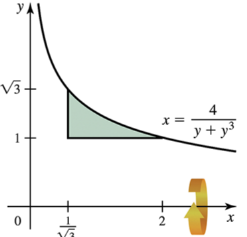
Problem 6.4.16
9-34. Shell method Let R be the region bounded by the following curves. Use the shell method to find the volume of the solid generated when R is revolved about indicated axis.
x = 4 / y + y³,x = 1/√3, and y=1; about the x-axis
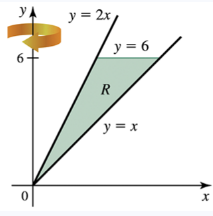
Problem 6.3.28
Let R be the region bounded by the following curves. Find the volume of the solid generated when R is revolved about the given axis.
y=x,y=2x, and y=6 ; about the y-axis
Problem 6.2.49
Find the area of the region described in the following exercises.
The region in the first quadrant bounded by y=x^2/3 and y=4
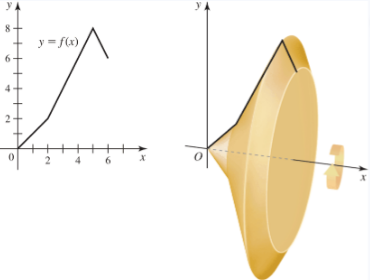
Problem 6.3.64
Let f(x) = {x if 0≤x≤2
2x−2 if 2<x≤5
−2x+18 if 5<x≤6.
Find the volume of the solid formed when the region bounded by the graph of f, the x-axis, and the line x=6 is revolved about the x-axis.
Problem 6.6.21
A 1.5-mm layer of paint is applied to one side of the following surfaces. Find the approximate volume of paint needed. Assume x and y are measured in meters.
The spherical zone generated when the curve y=√8x−x^2 on the interval 1≤x≤7 is revolved about the x-axis
Problem 6.1.72
Without evaluating integrals, prove that ∫₀² d/dx(12 sin πx²) dx=∫₀² d/dx (x¹⁰(2−x)³) dx.
Problem 6.4.37
35–38. Shell and washer methods Let R be the region bounded by the following curves. Use both the shell method and the washer method to find the volume of the solid generated when R is revolved about the indicated axis.
y = (x−2)³ −2,x=0, and y=25; about the y-axis
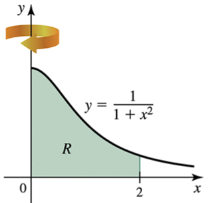
Problem 6.4.10
9-34. Shell method Let R be the region bounded by the following curves. Use the shell method to find the volume of the solid generated when R is revolved about indicated axis.
y = (1+x²)^−1,y = 0,x = 0, and x = 2; about the y-axis
Problem 6.2.45
Find the area of the region described in the following exercises.
The region bounded by y=2−|x|and y=x^2
Problem 6.5.14
9–20. Arc length calculations Find the arc length of the following curves on the given interval.
y = x^3/2 / 3 − x^1/2 on [4, 16]
Problem 6.5.9
9–20. Arc length calculations Find the arc length of the following curves on the given interval.
y = −8x−3 on [−2, 6] (Use calculus.)
Problem 6.7.13
13–20. Mass of one-dimensional objects Find the mass of the following thin bars with the given density function.
ρ(x)=1+sin x, for 0≤x≤π
Problem 6.4.22
9-34. Shell method Let R be the region bounded by the following curves. Use the shell method to find the volume of the solid generated when R is revolved about indicated axis.
x = x³ ,y = 1, and x = 0; about the x-axis
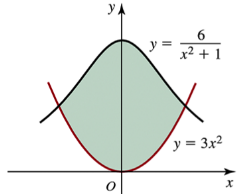
Problem 6.2.11
Determine the area of the shaded region in the following figures.
Problem 6.2.59
Find the area of the region described in the following exercises.
The region bounded by x=y(y−1) and y=x/3
Problem 6.7.2
Explain how to find the mass of a one-dimensional object with a variable density ρ.
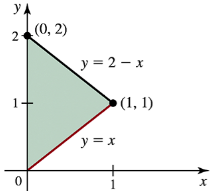
Problem 6.2.7
Express the area of the shaded region in Exercise 5 as the sum of two integrals with respect to y. Do not evaluate the integrals.
Problem 6.4.30
9-34. Shell method Let R be the region bounded by the following curves. Use the shell method to find the volume of the solid generated when R is revolved about indicated axis.
{Use of Tech} y = In x/x²,y = 0,x = 3, about the y-axis
Problem 6.3.55
Let R be the region bounded by the following curves. Find the volume of the solid generated when R is revolved about the given line.
y=2 sin x and y=0 on [0,π]; about y=−2
Problem 6.7.18
13–20. Mass of one-dimensional objects Find the mass of the following thin bars with the given density function.
ρ(x) = {1 if 0≤x≤2 {2 if 2<x≤3
Problem 6.3.1
Suppose a cut is made through a solid object perpendicular to the x-axis at a particular point x. Explain the meaning of A(x).
Problem 6.4.38
35–38. Shell and washer methods Let R be the region bounded by the following curves. Use both the shell method and the washer method to find the volume of the solid generated when R is revolved about the indicated axis.
y = 8,y = 2x+2,x = 0, and x=2; about the y-axis
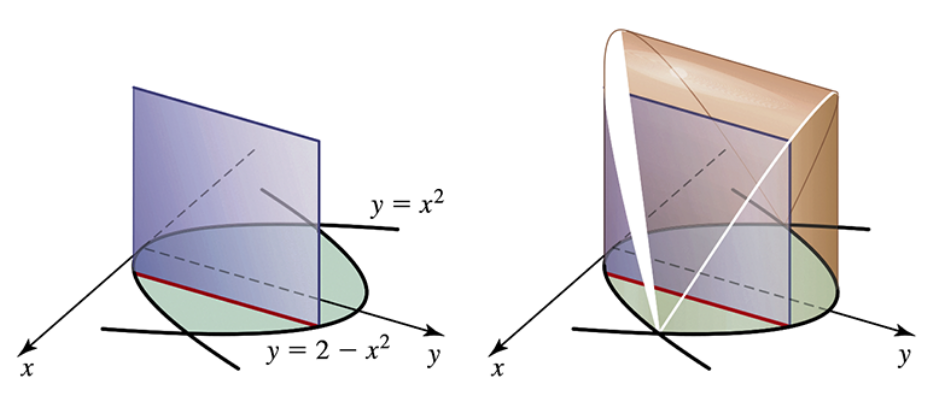
Problem 6.3.12
Use the general slicing method to find the volume of the following solids.
The solid whose base is the region bounded by the curves y=x^2 and y=2−x^2, and whose cross sections through the solid perpendicular to the x-axis are squares
Problem 6.7.21
Work from force How much work is required to move an object from x=0 to x=3 (measured in meters) in the presence of a force (in N) given by F(x)=2x acting along the x-axis?
Problem 6.1.69
Suppose f and g have continuous derivatives on an interval [a, b]. Prove that if f(a)=g(a) and f(b)=g(b), then ∫a^b f′(x) dx = ∫a^b g′(x) dx.
Problem 6.4.41
39–44. Shell method about other lines Let R be the region bounded by y = x²,x=1, and y=0. Use the shell method to find the volume of the solid generated when R is revolved about the following lines.
x =2
Problem 6.6.13
Find the area of the surface generated when the given curve is revolved about the given axis.
y=√1−x^2, for −1/2≤x≤1/2; about the x-axis