Ch. 6 - Applications of Integration
Briggs - Calculus: Early Transcendentals 3rd Edition
Briggs3rd EditionCalculus: Early TranscendentalsISBN: 9780136847243Not the one you use?Change textbook
Chapter 6, Problem 6.3.8c

Use the region R that is bounded by the graphs of y=1+√x,x=4, and y=1 complete the exercises.


Region R is revolved about the y-axis to form a solid of revolution whose cross sections are washers.


c. What is the area A(y) of a cross section of the solid at a point y in [1, 3]?

Verified step by step guidance
1
Step 1: Understand the problem. The region R is bounded by the graphs of y = 1 + √x, x = 4, and y = 1. When this region is revolved about the y-axis, the resulting solid has cross sections that are washers. We need to find the area A(y) of a cross section at a point y in the interval [1, 3].
Step 2: Express x in terms of y using the equation y = 1 + √x. Rearrange this equation to isolate x: √x = y - 1, so x = (y - 1)^2.
Step 3: Identify the inner and outer radii of the washer. The outer radius is determined by the curve x = (y - 1)^2, and the inner radius is determined by the vertical line x = 4. Since the solid is revolved about the y-axis, the radii are measured horizontally from the y-axis.
Step 4: Write the formula for the area of a washer. The area A(y) of a cross section is given by the formula: A(y) = π[R_outer^2 - R_inner^2], where R_outer is the distance from the y-axis to the curve x = (y - 1)^2, and R_inner is the distance from the y-axis to the line x = 4.
Step 5: Substitute the expressions for R_outer and R_inner into the formula. R_outer = (y - 1)^2 and R_inner = 4. Therefore, A(y) = π[((y - 1)^2)^2 - 4^2]. Simplify this expression to find the area A(y) in terms of y.

Verified video answer for a similar problem:

This video solution was recommended by our tutors as helpful for the problem above.
Video duration:
4m
Was this helpful?

Key Concepts

Here are the essential concepts you must grasp in order to answer the question correctly.

Solid of Revolution

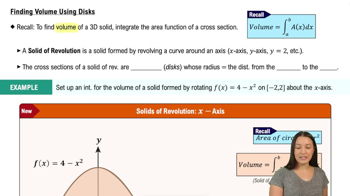
A solid of revolution is a three-dimensional shape created by rotating a two-dimensional area around an axis. In this case, the region R is revolved around the y-axis, resulting in a solid whose volume can be calculated using methods such as the disk or washer method. Understanding this concept is crucial for visualizing the shape formed and for applying the appropriate formulas to find its volume.
Recommended video:
04:48
Finding Volume Using Disks

Washer Method

The washer method is a technique used to calculate the volume of a solid of revolution when the cross-sections are washers, which are circular disks with a hole in the center. The volume is determined by integrating the area of these washers along the axis of rotation. For the given problem, identifying the outer and inner radii of the washers at a specific y-value is essential for finding the area A(y) of the cross-section.
Recommended video:
07:33
Euler's Method

Area of Cross Section

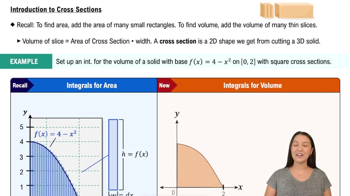
The area of a cross section refers to the area of the shape formed when a solid is sliced perpendicular to an axis. In this context, A(y) represents the area of the washer at a specific height y. To find A(y), one must calculate the difference between the areas of the outer and inner circles defined by the functions bounding the region, which is critical for determining the volume of the solid formed by revolving the region.
Recommended video:
05:38
Introduction to Cross Sections
Related Practice
Textbook Question

Piecewise velocity The velocity of a (fast) automobile on a straight highway is given by the function

v(t)={3t if 0t<2060 if 20t<452404t if t45v(t)= \(\begin{cases}\)3 t & \(\text\) { if } 0 \(\leq\) t<20 \\ 60 & \(\text\) { if } 20 \(\leq\) t<45 \\ 240-4 t & \(\text\) { if } t \(\geq\) 45\(\end{cases}\)

, where is measured in seconds and v has units of m/s. 


c. What is the distance traveled by the automobile in the first 60 s?

Textbook Question

Emptying a water trough A water trough has a semicircular cross section with a radius of 0.25 m and a length of 3 m (see figure).

c. If the radius is doubled, is the required work doubled? Explain.

1
views
Textbook Question

Blood flow A typical human heart pumps 70 mL of blood (the stroke volume) with each beat. Assuming a heart rate of 60 beats/min (1 beat/s), a reasonable model for the outflow rate of the heart is V′(t)=70(1+sin 2πt), where V(t) is the amount of blood (in milliliters) pumped over the interval [0,t],V(0)=0 and t is measured in seconds.


c. What is the cardiac output over a period of 1 min? (Use calculus; then check your answer with algebra.)

Textbook Question

Compressing and stretching a spring Suppose a force of 30 N is required to stretch and hold a spring 0.2 m from its equilibrium position.

c. How much work is required to stretch the spring 0.3 m from its equilibrium position?

Textbook Question

13–16. Displacement from velocity Consider an object moving along a line with the given velocity v. Assume time t is measured in seconds and velocities have units of m/s.


c. Find the distance traveled over the given interval.


v(t) = 3t²−6t on [0, 3]

Textbook Question

Acceleration A drag racer accelerates at a(t)=88 ft/s². Assume v(0)=0, s(0)=0, and t is measured in seconds.


c. At this rate, how long will it take the racer to travel 1/4 mi?

1
views