Ch. 6 - Applications of Integration
Briggs - Calculus: Early Transcendentals 3rd Edition
Briggs3rd EditionCalculus: Early TranscendentalsISBN: 9780136847243Not the one you use?Change textbook
Chapter 6, Problem 6.1.50c

Blood flow A typical human heart pumps 70 mL of blood (the stroke volume) with each beat. Assuming a heart rate of 60 beats/min (1 beat/s), a reasonable model for the outflow rate of the heart is V′(t)=70(1+sin 2πt), where V(t) is the amount of blood (in milliliters) pumped over the interval [0,t],V(0)=0 and t is measured in seconds.


c. What is the cardiac output over a period of 1 min? (Use calculus; then check your answer with algebra.)

Verified step by step guidance
1
Identify the given rate of blood flow as the derivative of the volume function: \(V'(t) = 70(1 + \sin(2\pi t))\), where \(V(t)\) is the total volume pumped from time 0 to time \(t\) seconds.
To find the cardiac output over 1 minute, which is 60 seconds, set up the definite integral of the rate function from \(t=0\) to \(t=60\): \(\displaystyle V(60) = \int_0^{60} 70(1 + \sin(2\pi t)) \, dt\)
Split the integral into two parts to simplify the calculation: \(\displaystyle V(60) = 70 \int_0^{60} 1 \, dt + 70 \int_0^{60} \sin(2\pi t) \, dt\)
Evaluate each integral separately: - The integral of 1 with respect to \(t\) over \([0,60]\) is straightforward: \(\int_0^{60} 1 \, dt = 60\). - For the integral of \(\sin(2\pi t)\), use the antiderivative formula for sine: \(\int \sin(ax) \, dx = -\frac{1}{a} \cos(ax) + C\). Apply this to \(\int_0^{60} \sin(2\pi t) \, dt\).
Combine the results of the integrals and multiply by 70 to find \(V(60)\), which represents the total volume pumped in 60 seconds (1 minute). This gives the cardiac output over that period. Finally, verify your answer by considering the average flow rate algebraically and multiplying by the total time.

Verified video answer for a similar problem:

This video solution was recommended by our tutors as helpful for the problem above.
Video duration:
5m
Was this helpful?

Key Concepts

Here are the essential concepts you must grasp in order to answer the question correctly.

Derivative and Rate of Change

The derivative represents the instantaneous rate of change of a function. In this problem, V′(t) models the rate at which blood is pumped at time t, showing how volume changes per second. Understanding derivatives helps interpret how the heart's outflow varies over time.
Recommended video:
04:16
Intro To Related Rates

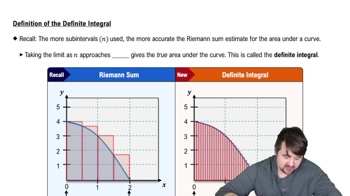
Definite Integral and Accumulated Quantity

The definite integral of a rate function over an interval gives the total accumulated quantity during that time. Here, integrating V′(t) from 0 to 60 seconds calculates the total blood volume pumped in one minute, linking rate of flow to total output.
Recommended video:
05:43
Definition of the Definite Integral

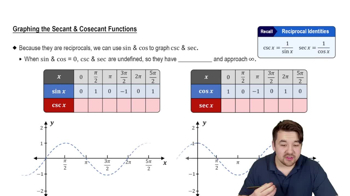
Periodic Functions and Sinusoidal Models

Sinusoidal functions like sine model periodic phenomena such as heartbeats. The term sin(2πt) reflects the cyclical nature of blood flow with each beat, allowing the rate function to capture fluctuations around the average stroke volume.
Recommended video:
6:22
Graphs of Secant and Cosecant Functions
Related Practice
Textbook Question

Piecewise velocity The velocity of a (fast) automobile on a straight highway is given by the function

v(t)={3t if 0t<2060 if 20t<452404t if t45v(t)= \(\begin{cases}\)3 t & \(\text\) { if } 0 \(\leq\) t<20 \\ 60 & \(\text\) { if } 20 \(\leq\) t<45 \\ 240-4 t & \(\text\) { if } t \(\geq\) 45\(\end{cases}\)

, where is measured in seconds and v has units of m/s. 


c. What is the distance traveled by the automobile in the first 60 s?

Textbook Question

{Use of Tech} Oscillating motion A mass hanging from a spring is set in motion, and its ensuing velocity is given by v(t) = 2π cos πt, for t≥0. Assume the positive direction is upward and s(0)=0. 


c. At what times does the mass reach its low point the first three times? 

Textbook Question

Emptying a water trough A water trough has a semicircular cross section with a radius of 0.25 m and a length of 3 m (see figure).

c. If the radius is doubled, is the required work doubled? Explain.

1
views
Textbook Question

Use the region R that is bounded by the graphs of y=1+√x,x=4, and y=1 complete the exercises.


Region R is revolved about the y-axis to form a solid of revolution whose cross sections are washers.


c. What is the area A(y) of a cross section of the solid at a point y in [1, 3]?

Textbook Question

13–16. Displacement from velocity Consider an object moving along a line with the given velocity v. Assume time t is measured in seconds and velocities have units of m/s.


c. Find the distance traveled over the given interval.


v(t) = 3t²−6t on [0, 3]

Textbook Question

Acceleration A drag racer accelerates at a(t)=88 ft/s². Assume v(0)=0, s(0)=0, and t is measured in seconds.


c. At this rate, how long will it take the racer to travel 1/4 mi?

1
views