Ch. 6 - Applications of Integration
Briggs - Calculus: Early Transcendentals 3rd Edition
Briggs3rd EditionCalculus: Early TranscendentalsISBN: 9780136847243Not the one you use?Change textbook
Chapter 6, Problem 6.7.42c

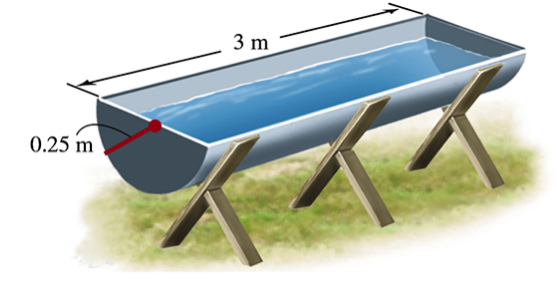
Emptying a water trough A water trough has a semicircular cross section with a radius of 0.25 m and a length of 3 m (see figure).
c. If the radius is doubled, is the required work doubled? Explain.

Verified step by step guidance
1
Step 1: Understand the problem context. The water trough has a semicircular cross section with radius \(r = 0.25\) m and length \(L = 3\) m. The work required to empty the trough depends on the volume of water and the height it must be lifted.
Step 2: Recall the formula for work done in lifting water. Work is the integral of force times distance. The force is the weight of the water, which depends on the volume and density, and the distance is the height the water is lifted.
Step 3: Express the volume of water in terms of the radius. The cross-sectional area of the semicircle is \(A = \frac{1}{2} \pi r^2\), so the volume is \(V = A \times L = \frac{1}{2} \pi r^2 L\).
Step 4: Analyze how doubling the radius affects the volume and the height the water must be lifted. Doubling the radius changes the cross-sectional area by a factor of \(4\) (since area depends on \(r^2\)), and the height the water must be lifted also changes proportionally to the radius.
Step 5: Conclude that the work required is not simply doubled when the radius is doubled because work depends on both the volume (which scales with \(r^2\)) and the lifting height (which scales with \(r\)), so the total work scales with \(r^3\).

Verified video answer for a similar problem:

This video solution was recommended by our tutors as helpful for the problem above.
Video duration:
3m
Was this helpful?

Key Concepts

Here are the essential concepts you must grasp in order to answer the question correctly.

Work Done by a Variable Force

Work in calculus is often calculated as the integral of a force over a distance. When emptying a trough, the force varies with the depth of the water, so the work is found by integrating the weight of water lifted at each layer times the distance it is lifted.
Recommended video:
05:40
Work Done On A Spring (Hooke's Law)

Volume and Cross-Sectional Area of a Semicircle

The volume of water in the trough depends on the semicircular cross-sectional area multiplied by the length. The area of a semicircle is (1/2)πr², so doubling the radius increases the area, and thus the volume, by a factor of four.
Recommended video:
05:38
Introduction to Cross Sections

Relationship Between Radius and Work Required

Doubling the radius affects both the volume of water and the height it must be lifted. Since volume scales with the square of the radius and the lifting height scales linearly, the total work does not simply double but increases by a larger factor.
Recommended video:
09:38
Pumping Liquids Example 3
Related Practice
Textbook Question

Piecewise velocity The velocity of a (fast) automobile on a straight highway is given by the function

v(t)={3t if 0t<2060 if 20t<452404t if t45v(t)= \(\begin{cases}\)3 t & \(\text\) { if } 0 \(\leq\) t<20 \\ 60 & \(\text\) { if } 20 \(\leq\) t<45 \\ 240-4 t & \(\text\) { if } t \(\geq\) 45\(\end{cases}\)

, where is measured in seconds and v has units of m/s. 


c. What is the distance traveled by the automobile in the first 60 s?

Textbook Question

Determine whether the following statements are true and give an explanation or counterexample.


c. ∫₀¹(x−x^2) dx=∫₀¹(√y−y) dy

2
views
Textbook Question

Blood flow A typical human heart pumps 70 mL of blood (the stroke volume) with each beat. Assuming a heart rate of 60 beats/min (1 beat/s), a reasonable model for the outflow rate of the heart is V′(t)=70(1+sin 2πt), where V(t) is the amount of blood (in milliliters) pumped over the interval [0,t],V(0)=0 and t is measured in seconds.


c. What is the cardiac output over a period of 1 min? (Use calculus; then check your answer with algebra.)

Textbook Question

Use the region R that is bounded by the graphs of y=1+√x,x=4, and y=1 complete the exercises.


Region R is revolved about the y-axis to form a solid of revolution whose cross sections are washers.


c. What is the area A(y) of a cross section of the solid at a point y in [1, 3]?

Textbook Question

Compressing and stretching a spring Suppose a force of 30 N is required to stretch and hold a spring 0.2 m from its equilibrium position.

c. How much work is required to stretch the spring 0.3 m from its equilibrium position?

Textbook Question

13–16. Displacement from velocity Consider an object moving along a line with the given velocity v. Assume time t is measured in seconds and velocities have units of m/s.


c. Find the distance traveled over the given interval.


v(t) = 3t²−6t on [0, 3]