
Ch. 6 - Applications of Integration
Briggs - Calculus: Early Transcendentals 3rd Edition
Briggs3rd EditionCalculus: Early TranscendentalsISBN: 9780136847243Not the one you use?Change textbook
Chapter 6, Problem 6.3.40

Let R be the region bounded by the following curves. Find the volume of the solid generated when R is revolved about the given axis.


y=x^2,y=2−x, and y=0; about the y-axis

Verified step by step guidance
1
First, identify the region R bounded by the curves: \(y = x^2\), \(y = 2 - x\), and \(y = 0\). Sketching these curves helps visualize the area and the limits of integration.
Find the points of intersection between the curves to determine the bounds for \(x\). Solve \(x^2 = 2 - x\) to find the \(x\)-values where the curves \(y = x^2\) and \(y = 2 - x\) intersect.
Since the solid is generated by revolving the region around the y-axis, use the method of cylindrical shells. The volume element for shells is given by \(dV = 2\pi \cdot (\text{radius}) \cdot (\text{height}) \cdot dx\).
Express the radius and height of a typical shell in terms of \(x\). The radius is the distance from the y-axis, which is \(x\), and the height is the vertical distance between the curves, which is \((2 - x) - x^2\).
Set up the integral for the volume as \(V = \int_{a}^{b} 2\pi x \left[(2 - x) - x^2\right] dx\), where \(a\) and \(b\) are the \(x\)-values found from the intersection points. This integral will give the volume of the solid.

Verified video answer for a similar problem:

This video solution was recommended by our tutors as helpful for the problem above.
Video duration:
7m
Was this helpful?

Key Concepts

Here are the essential concepts you must grasp in order to answer the question correctly.

Finding the Region Bounded by Curves

To find the volume of a solid generated by revolving a region, first identify the area bounded by the given curves. This involves determining the points of intersection and understanding the shape enclosed by y = x², y = 2 - x, and y = 0. Accurate sketching or solving equations helps visualize the region R.
Recommended video:
05:06
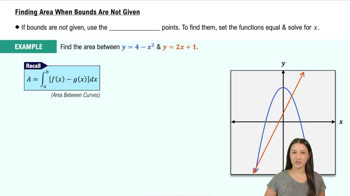
Finding Area When Bounds Are Not Given

Method of Cylindrical Shells

When revolving a region around the y-axis, the cylindrical shells method is often used. It involves integrating the volume of thin cylindrical shells with radius equal to the x-value, height given by the difference of functions, and thickness dx. This method simplifies volume calculation when the axis of rotation is vertical.
Recommended video:
07:33
Euler's Method

Setting up and Evaluating Definite Integrals

Calculating the volume requires setting up a definite integral with proper limits corresponding to the region's x-values. The integral sums the volumes of infinitesimal shells or disks. Correctly expressing the radius, height, and limits ensures accurate evaluation of the volume.
Recommended video:
05:43
Definition of the Definite Integral