Ch. 6 - Applications of Integration
Briggs - Calculus: Early Transcendentals 3rd Edition
Briggs3rd EditionCalculus: Early TranscendentalsISBN: 9780136847243Not the one you use?Change textbook
Chapter 6, Problem 6.5.12

9–20. Arc length calculations Find the arc length of the following curves on the given interval.
y = 3 ln x− x²/24 on [1, 6]

Verified step by step guidance
1
Recall the formula for the arc length of a curve \(y = f(x)\) on the interval \([a, b]\): \[L = \int_a^b \sqrt{1 + \left(\frac{dy}{dx}\right)^2} \, dx\]
Find the derivative \(\frac{dy}{dx}\) of the given function \(y = 3 \ln x - \frac{x^2}{24}\). Use the derivative rules for logarithmic and polynomial functions: \[\frac{dy}{dx} = 3 \cdot \frac{1}{x} - \frac{2x}{24}\]
Simplify the derivative expression: \[\frac{dy}{dx} = \frac{3}{x} - \frac{x}{12}\]
Substitute \(\frac{dy}{dx}\) into the arc length formula under the square root: \[L = \int_1^6 \sqrt{1 + \left(\frac{3}{x} - \frac{x}{12}\right)^2} \, dx\]
Set up the integral for evaluation. At this point, you can either simplify the expression inside the square root further or use numerical methods or a calculator to approximate the integral value over the interval \([1, 6]\).

Verified video answer for a similar problem:

This video solution was recommended by our tutors as helpful for the problem above.
Video duration:
3m
Was this helpful?

Key Concepts

Here are the essential concepts you must grasp in order to answer the question correctly.

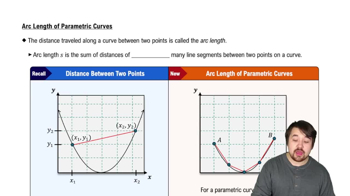
Arc Length Formula

The arc length of a curve y = f(x) from x = a to x = b is found using the integral formula L = ∫_a^b √(1 + (dy/dx)²) dx. This formula sums the lengths of infinitesimal line segments along the curve, providing the total distance traveled along it.
Recommended video:
06:29
Arc Length of Parametric Curves

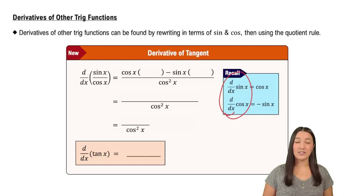
Derivative of the Function

To apply the arc length formula, you need the derivative dy/dx of the function y = 3 ln x − x²/24. The derivative measures the slope of the curve at each point, which is essential for calculating the integrand √(1 + (dy/dx)²).
Recommended video:
06:30
Derivatives of Other Trig Functions

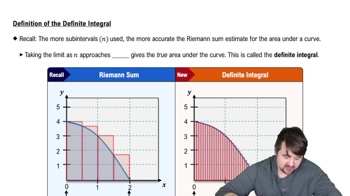
Definite Integration

After finding the integrand, you evaluate the definite integral from x = 1 to x = 6. This process sums the continuous values of √(1 + (dy/dx)²) over the interval, yielding the exact arc length of the curve between the specified bounds.
Recommended video:
05:43
Definition of the Definite Integral
Related Practice
Textbook Question

Let R be the region bounded by the following curves. Find the volume of the solid generated when R is revolved about the given axis.


y=x^2,y=2−x, and y=0; about the y-axis

Textbook Question

45–48. Shell and washer methods about other lines Use both the shell method and the washer method to find the volume of the solid that is generated when the region in the first quadrant bounded by y = x²,y=1, and x=0 is revolved about the following lines. 


x = -1

1
views
Textbook Question

Look again at the region R in Figure 6.38 (p. 439). Explain why it would be difficult to use the washer method to find the volume of the solid of revolution that results when R is revolved about the y-axis.

1
views
Textbook Question

Suppose the region bounded by the curve y=f(x) from x=0 to x=4 (see figure) is revolved about the x-axis to form a solid of revolution. Use left, right, and midpoint Riemann sums, with n=4 subintervals of equal length, to estimate the volume of the solid of revolution.

Textbook Question

Use the general slicing method to find the volume of the following solids.

The solid whose base is the region bounded by the curves y=x^2 and y=2−x^2, and whose cross sections through the solid perpendicular to the x-axis are squares

1
views
Textbook Question

35–38. Shell and washer methods Let R be the region bounded by the following curves. Use both the shell method and the washer method to find the volume of the solid generated when R is revolved about the indicated axis.


y = 8,y = 2x+2,x = 0, and x=2; about the y-axis

1
views