
Ch. 6 - Applications of Integration
Briggs - Calculus: Early Transcendentals 3rd Edition
Briggs3rd EditionCalculus: Early TranscendentalsISBN: 9780136847243Not the one you use?Change textbook
Chapter 6, Problem 6.2.E.71

Find the area of the following regions, expressing your results in terms of the positive integer n≥2.


Let Aₙ be the area of the region bounded by f(x)=x^1/n and g(x)=x^n on the interval [0,1], where n is a positive integer. Evaluate lim n→∞ Aₙ and interpret the result. br

Verified step by step guidance
1
Step 1: Understand the problem. You are tasked with finding the area of the region bounded by two functions, f(x) = x^(1/n) and g(x) = x^n, on the interval [0,1]. Then, you need to evaluate the limit of this area as n approaches infinity and interpret the result.
Step 2: Set up the integral for the area. The area Aₙ is given by the integral of the difference between the upper function f(x) = x^(1/n) and the lower function g(x) = x^n over the interval [0,1]. The formula for the area is: An=01(x1/n-xn)dx
Step 3: Break the integral into two parts. The integral can be split into two separate integrals: An=01x1/ndx-01xndx. Evaluate each integral separately.
Step 4: Evaluate the first integral. For the integral 01x1/ndx, use the power rule for integration: 01xkdx=1k+1, where k = 1/n.
Step 5: Evaluate the second integral. For the integral 01xndx, use the same power rule for integration, where k = n. After evaluating both integrals, subtract the second result from the first to find Aₙ. Finally, take the limit as n approaches infinity to determine lim n→∞ Aₙ and interpret the result.

Verified video answer for a similar problem:

This video solution was recommended by our tutors as helpful for the problem above.
Video duration:
6m
Was this helpful?

Key Concepts

Here are the essential concepts you must grasp in order to answer the question correctly.

Definite Integrals

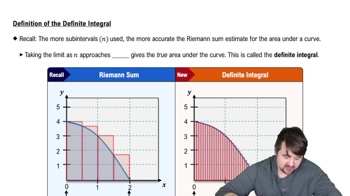
Definite integrals are used to calculate the area under a curve between two points on the x-axis. In this context, the area Aₙ can be found by integrating the difference between the functions f(x) and g(x) over the interval [0, 1]. Understanding how to set up and evaluate definite integrals is crucial for solving the problem.
Recommended video:
05:43
Definition of the Definite Integral

Limits

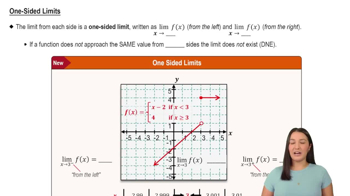
Limits are fundamental in calculus, particularly when analyzing the behavior of functions as they approach a certain point or infinity. In this question, evaluating lim n→∞ Aₙ requires understanding how the area Aₙ changes as n increases without bound, which can reveal insights about the functions involved.
Recommended video:
05:50
One-Sided Limits

Function Behavior

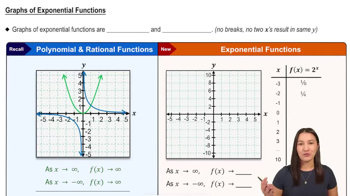
Analyzing the behavior of the functions f(x) = x^(1/n) and g(x) = x^n as n approaches infinity is essential. As n increases, f(x) approaches 1 for x in (0, 1) and g(x) approaches 0. Understanding these behaviors helps in determining the area between the curves and interpreting the limit of Aₙ.
Recommended video:
5:46
Graphs of Exponential Functions