
Textbook Question
Surface area and volume Let f(x) = 1/3 x³ and let R be the region bounded by the graph of f and the x-axis on the interval [0, 2].
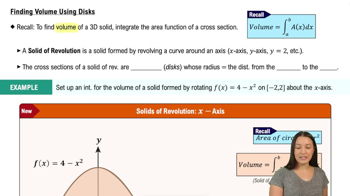
c. Find the volume of the solid generated when R is revolved about the x-axis.


 Verified step by step guidance
 04:48
04:48
 07:33
07:33 06:11
06:11Surface area and volume Let f(x) = 1/3 x³ and let R be the region bounded by the graph of f and the x-axis on the interval [0, 2].
c. Find the volume of the solid generated when R is revolved about the x-axis.
43–55. Volumes of solids Choose the general slicing method, the disk/washer method, or the shell method to answer the following questions.
The region bounded by the curves y = sec x and y=2, for 0 ≤ x ≤ π/3, is revolved about the x-axis. What is the volume of the solid that is generated?
Surface area of a cone Find the surface area of a cone (excluding the base) with radius 4 and height 8 using integration and a surface area integral.
Find the area of the following regions, expressing your results in terms of the positive integer n≥2.
Let Aₙ be the area of the region bounded by f(x)=x^1/n and g(x)=x^n on the interval [0,1], where n is a positive integer. Evaluate lim n→∞ Aₙ and interpret the result. br
Suppose a cut is made through a solid object perpendicular to the x-axis at a particular point x. Explain the meaning of A(x).
14–25. {Use of Tech} Areas of regions Determine the area of the given region.
The region bounded by y = ln x,y = 1, and x = 1