Ch. 6 - Applications of Integration
Briggs - Calculus: Early Transcendentals 3rd Edition
Briggs3rd EditionCalculus: Early TranscendentalsISBN: 9780136847243Not the one you use?Change textbook
Chapter 6, Problem 6.R.50

43–55. Volumes of solids Choose the general slicing method, the disk/washer method, or the shell method to answer the following questions.


The region bounded by the curves y = sec x and y=2, for 0 ≤ x ≤ π/3, is revolved about the x-axis. What is the volume of the solid that is generated? 

Verified step by step guidance
1
First, identify the region bounded by the curves \(y = \sec x\) and \(y = 2\) on the interval \(0 \leq x \leq \frac{\pi}{3}\). Since \(\sec x = \frac{1}{\cos x}\), note that \(\sec x\) is increasing on this interval and \(\sec 0 = 1\), \(\sec \frac{\pi}{3} = 2\), so the curves intersect at \(x = \frac{\pi}{3}\).
Since the region is revolved about the x-axis, consider the vertical slices perpendicular to the x-axis. The volume can be found using the washer method because the region lies between two curves above the x-axis.
Set up the volume integral using the washer method formula: \(V = \pi \int_a^b \left(R(x)^2 - r(x)^2\right) \, dx\), where \(R(x)\) is the outer radius and \(r(x)\) is the inner radius of the washers.
Determine the outer and inner radii. The outer radius \(R(x)\) is the distance from the x-axis to the upper curve \(y=2\), so \(R(x) = 2\). The inner radius \(r(x)\) is the distance from the x-axis to the lower curve \(y=\sec x\), so \(r(x) = \sec x\).
Write the integral explicitly: \(V = \pi \int_0^{\frac{\pi}{3}} \left(2^2 - (\sec x)^2\right) \, dx = \pi \int_0^{\frac{\pi}{3}} \left(4 - \sec^2 x\right) \, dx\). This integral can then be evaluated to find the volume.

Verified video answer for a similar problem:

This video solution was recommended by our tutors as helpful for the problem above.
Video duration:
4m
Was this helpful?

Key Concepts

Here are the essential concepts you must grasp in order to answer the question correctly.

Volume of Solids of Revolution

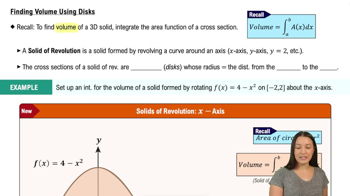
This concept involves finding the volume of a 3D solid formed by rotating a 2D region around an axis. The volume is computed by integrating cross-sectional areas perpendicular to the axis of rotation, using methods like disks, washers, or shells.
Recommended video:
04:48
Finding Volume Using Disks

Disk and Washer Methods

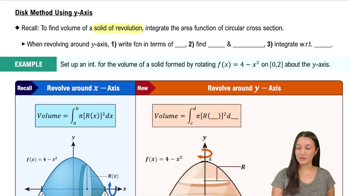
The disk method calculates volume by summing up circular cross-sections (disks) when the region touches the axis of rotation. The washer method extends this by subtracting inner holes, useful when the region is bounded by two curves, creating hollow cross-sections.
Recommended video:
06:30
Disk Method Using y-Axis

Choosing the Axis and Limits of Integration

Identifying the axis of rotation (here, the x-axis) and the interval for integration (0 to π/3) is crucial. This determines the shape of cross-sections and the bounds for the integral that computes the volume of the solid.
Recommended video:
07:51
Choosing a Convergence Test