
Textbook Question
Filling a tank A 2000-liter cistern is empty when water begins flowing into it (at t=0 at a rate (in L/min) given by Q′(t) = 3√t, where t is measured in minutes.
a. How much water flows into the cistern in 1 hour?

 Verified step by step guidance
 09:07
09:07
 06:29
06:29 6:04
6:04Filling a tank A 2000-liter cistern is empty when water begins flowing into it (at t=0 at a rate (in L/min) given by Q′(t) = 3√t, where t is measured in minutes.
a. How much water flows into the cistern in 1 hour?
Determine whether the following statements are true and give an explanation or counterexample.
a. If the curve y=f(x) on the interval [a, b] is revolved about the y-axis, the area of the surface generated is ∫f(b)f(a) 2πf(y)√1+f′(y)^2 dy.
Explain why or why not Determine whether the following statements are true and give an explanation or counterexample.
a. When using the shell method, the axis of the cylindrical shells is parallel to the axis of revolution.
Bike race Theo and Sasha start at the same place on a straight road, riding bikes with the following velocities (measured in mi/hr). Assume t is measured in hours.
Theo: vT(t)=10, for t≥0
Sasha: vS(t)=15t, for 0≤t≤1, and vS(t)=15, for t>1
a. Graph the velocity function for both riders.
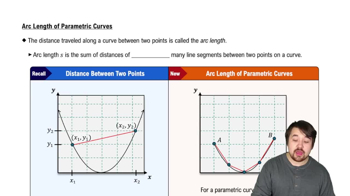
Explain the steps required to find the length of a curve x = g(y) between y=c and y=d.
Calculating work for different springs Calculate the work required to stretch the following springs 1.25 m from their equilibrium positions. Assume Hooke’s law is obeyed.
a. A spring that requires 100 J of work to be stretched 0.5 m from its equilibrium position