Ch. 6 - Applications of Integration
Briggs - Calculus: Early Transcendentals 3rd Edition
Briggs3rd EditionCalculus: Early TranscendentalsISBN: 9780136847243Not the one you use?Change textbook
Chapter 6, Problem 6.1.48a

Filling a tank A 2000-liter cistern is empty when water begins flowing into it (at t=0 at a rate (in L/min) given by Q′(t) = 3√t, where t is measured in minutes.


a. How much water flows into the cistern in 1 hour?

Verified step by step guidance
1
Identify the given rate of water flow into the cistern as a function of time: \(Q'(t) = 3\sqrt{t}\) liters per minute, where \(t\) is in minutes.
Recognize that \(Q'(t)\) represents the derivative of the volume of water \(Q(t)\) with respect to time, so to find the total volume of water that has flowed in by time \(t\), you need to integrate \(Q'(t)\) over the interval from 0 to \(t\).
Set up the definite integral to find the total volume of water that has flowed into the cistern in 1 hour (which is 60 minutes): \(\displaystyle Q(60) = \int_0^{60} 3\sqrt{t} \, dt\)
Rewrite the integrand \(3\sqrt{t}\) as \(3t^{1/2}\) to make integration straightforward.
Integrate \(3t^{1/2}\) with respect to \(t\) using the power rule for integration: \(\int 3t^{1/2} \, dt = 3 \cdot \frac{t^{3/2}}{\frac{3}{2}} + C = 2t^{3/2} + C\). Then evaluate this antiderivative from 0 to 60 to find the total volume of water that has flowed into the cistern in 1 hour.

Verified video answer for a similar problem:

This video solution was recommended by our tutors as helpful for the problem above.
Video duration:
3m
Was this helpful?

Key Concepts

Here are the essential concepts you must grasp in order to answer the question correctly.

Definite Integral

A definite integral calculates the total accumulation of a quantity over an interval. In this problem, integrating the rate function Q′(t) from 0 to 60 minutes gives the total volume of water that has flowed into the cistern during that time.
Recommended video:
05:43
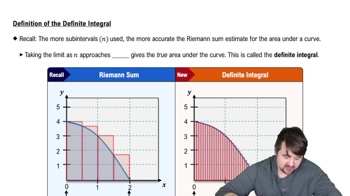
Definition of the Definite Integral

Rate of Change and Accumulation

The rate function Q′(t) represents how fast water flows into the tank at any time t. Understanding that integrating this rate over time accumulates the total amount of water is essential to solving the problem.
Recommended video:
04:16
Intro To Related Rates

Units and Time Conversion

Since the rate is given in liters per minute and time is in minutes, it is important to convert the time interval correctly (1 hour = 60 minutes) to ensure the integral limits match the units and yield a meaningful total volume.
Recommended video:
5:10
Evaluate Composite Functions - Values on Unit Circle
Related Practice
Textbook Question

Consider the following curves on the given intervals.  


a. Write the integral that gives the area of the surface generated when the curve is revolved about the given axis. 


y=tan x , for 0≤x≤π/4; about the x-axis 

Textbook Question

Critical depth A large tank has a plastic window on one wall that is designed to withstand a force of 90,000 N. The square window is 2 m on a side, and its lower edge is 1 m from the bottom of the tank.

a. If the tank is filled to a depth of 4 m, will the window withstand the resulting force?

1
views
Textbook Question

Mass of two bars Two bars of length L have densities ρ₁(x) = 4e^−x and ρ₂(x) = 6e^−2x, for 0≤x≤L.

a. For what values of L is bar 1 heavier than bar 2?

1
views
Textbook Question

Determine whether the following statements are true and give an explanation or counterexample. 


a. If the curve y=f(x) on the interval [a, b] is revolved about the y-axis, the area of the surface generated is ∫f(b)f(a) 2πf(y)√1+f′(y)^2 dy.

Textbook Question

Explain why or why not Determine whether the following statements are true and give an explanation or counterexample.

a. When using the shell method, the axis of the cylindrical shells is parallel to the axis of revolution.

1
views
Textbook Question

Bike race Theo and Sasha start at the same place on a straight road, riding bikes with the following velocities (measured in mi/hr). Assume t is measured in hours.

Theo: vT(t)=10, for t≥0

Sasha: vS(t)=15t, for 0≤t≤1, and vS(t)=15, for t>1


a. Graph the velocity function for both riders. 

1
views