
Ch. 6 - Applications of Integration
Briggs - Calculus: Early Transcendentals 3rd Edition
Briggs3rd EditionCalculus: Early TranscendentalsISBN: 9780136847243Not the one you use?Change textbook
Chapter 6, Problem 6.1.9c

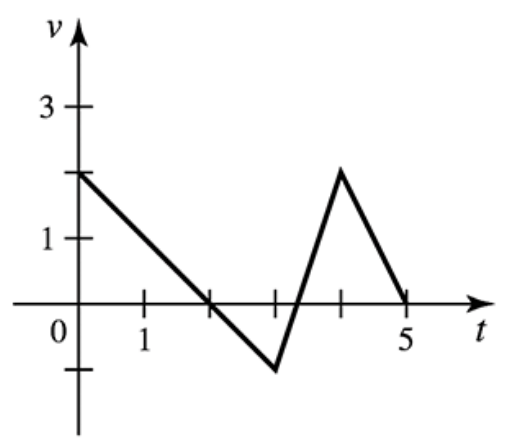
9–10. Velocity graphs The figures show velocity functions for motion along a line. Assume the motion begins with an initial position of s(0)=0. Determine the following.
img
c. The position at t=5

Verified step by step guidance
1
Understand that the position function \(s(t)\) is the integral of the velocity function \(v(t)\) over time, starting from the initial position \(s(0) = 0\).
Identify the intervals on the graph where the velocity function changes. From the graph, note the velocity values and the time intervals: from \(t=0\) to \(t=2\), velocity decreases linearly from 2 to -2; from \(t=2\) to \(t=3\), velocity increases linearly from -2 to 3; from \(t=3\) to \(t=5\), velocity decreases linearly from 3 to 0.
Calculate the area under the velocity curve for each interval, as the integral of velocity over time gives the change in position. Since the graph consists of straight lines, these areas can be found by calculating the areas of geometric shapes (triangles and trapezoids) formed between the velocity curve and the time axis.
Sum the areas from each interval, taking care to consider the sign of the velocity (areas below the time axis represent negative displacement). This sum will give the net change in position from \(t=0\) to \(t=5\).
Add the net change in position to the initial position \(s(0) = 0\) to find the position at \(t=5\), \(s(5)\).

Verified video answer for a similar problem:

This video solution was recommended by our tutors as helpful for the problem above.
Video duration:
5m
Was this helpful?

Key Concepts

Here are the essential concepts you must grasp in order to answer the question correctly.

Velocity and Position Relationship

Velocity is the rate of change of position with respect to time. To find the position at a given time, you integrate the velocity function over the time interval, starting from the initial position. This means the position is the accumulated area under the velocity-time graph.
Recommended video:
06:29
Derivatives Applied To Velocity

Definite Integral as Area Under the Curve

The definite integral of a velocity function from time a to b represents the net displacement during that interval. Graphically, this corresponds to the area between the velocity curve and the time axis, where areas above the axis are positive and below are negative.
Recommended video:
05:43
Definition of the Definite Integral

Piecewise Linear Functions and Area Calculation

When the velocity graph is piecewise linear, the area under the curve can be found by calculating areas of simple geometric shapes like triangles and rectangles. Summing these areas with appropriate signs gives the net displacement, which is used to find the position.
Recommended video:
05:36
Piecewise Functions
Related Practice
Textbook Question

Where do they meet? Kelly started at noon (t=0) riding a bike from Niwot to Berthoud, a distance of 20 km, with velocity v(t) = 15 / (t + 1)² (decreasing because of fatigue). Sandy started at noon (t=0) riding a bike in the opposite direction from Berthoud to Niwot with velocity u(t) = 20 / (t + 1)² (also decreasing because of fatigue). Assume distance is measured in kilometers and time is measured in hours.


c. When do they meet? How far has each person traveled when they meet?

Textbook Question

Probe speed A data collection probe is dropped from a stationary balloon, and it falls with a velocity (in m/s) given by v(t) = 9.8t, neglecting air resistance. After 10 s, a chute deploys and the probe immediately slows to a constant speed of 10 m/s, which it maintains until it enters the ocean.


c. If the probe was released from an altitude of 3 km, when does it enter the ocean?

Textbook Question

Explain why or why not Determine whether the following statements are true and give an explanation or counterexample.

c. If a region is revolved about the x-axis, then in principle, it is possible to use the disk/washer method and integrate with respect to x or to use the shell method and integrate with respect to y.

Textbook Question

13–16. Displacement from velocity Consider an object moving along a line with the given velocity v. Assume time t is measured in seconds and velocities have units of m/s.


c. Find the distance traveled over the given interval.


v(t) = 4t³ - 24t²+20t on [0, 5]

Textbook Question

Explain why or why not Determine whether the following statements are true and give an explanation or counterexample.


Arc length may be negative if f(x) < 0 on part of the interval in question.

Textbook Question

Depletion of natural resources Suppose r(t) = r0e^−kt, with k>0, is the rate at which a nation extracts oil, where r0=10⁷ barrels/yr is the current rate of extraction. Suppose also that the estimate of the total oil reserve is 2×10⁹ barrels. 


c. Find the minimum decay constant k for which the total oil reserves will last forever.

2
views