
Ch. 6 - Applications of Integration
Briggs - Calculus: Early Transcendentals 3rd Edition
Briggs3rd EditionCalculus: Early TranscendentalsISBN: 9780136847243Not the one you use?Change textbook
Chapter 6, Problem 6.1.14c

13–16. Displacement from velocity Consider an object moving along a line with the given velocity v. Assume time t is measured in seconds and velocities have units of m/s.


c. Find the distance traveled over the given interval.


v(t) = 4t³ - 24t²+20t on [0, 5]

Verified step by step guidance
1
Step 1: Understand the problem. The goal is to find the total distance traveled by the object over the interval [0, 5]. Distance is calculated by integrating the absolute value of the velocity function v(t) over the given interval.
Step 2: Identify the velocity function v(t) = 4t³ - 24t² + 20t and the interval [0, 5]. To compute the distance, we need to account for any changes in direction (where v(t) = 0) because the absolute value of velocity is required.
Step 3: Solve for the critical points where v(t) = 0. Set 4t³ - 24t² + 20t = 0 and factorize the equation: t(4t² - 24t + 20) = 0. Solve for t to find the points where the velocity changes sign within the interval [0, 5].
Step 4: Determine the sign of v(t) in each subinterval created by the critical points. This involves testing the sign of v(t) in intervals such as [0, t₁], [t₁, t₂], ..., [tₙ, 5], where t₁, t₂, ..., tₙ are the critical points. Use these signs to apply the absolute value of v(t) in the integration.
Step 5: Compute the total distance traveled by integrating |v(t)| over each subinterval. For each subinterval, integrate the absolute value of v(t) and sum the results to find the total distance. Use the formula: ∫|v(t)| dt from t=a to t=b for each subinterval.

Verified video answer for a similar problem:

This video solution was recommended by our tutors as helpful for the problem above.
Video duration:
4m
Was this helpful?

Key Concepts

Here are the essential concepts you must grasp in order to answer the question correctly.

Velocity Function

The velocity function v(t) describes the rate of change of an object's position with respect to time. In this case, v(t) = 4t³ - 24t² + 20t is a polynomial function that indicates how the object's speed varies over time. Understanding this function is crucial for determining how far the object travels during a specific time interval.
Recommended video:
10:17
Using The Velocity Function

Definite Integral

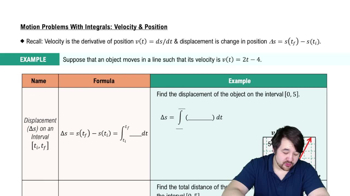
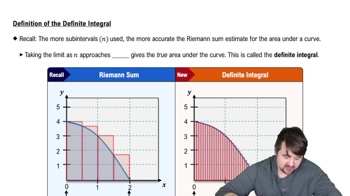
To find the distance traveled over a time interval, we use the definite integral of the velocity function. The integral calculates the net area under the velocity curve from the start to the end of the interval, which corresponds to the total displacement. In this problem, we will evaluate the integral of v(t) from t = 0 to t = 5.
Recommended video:
05:43
Definition of the Definite Integral

Distance vs. Displacement

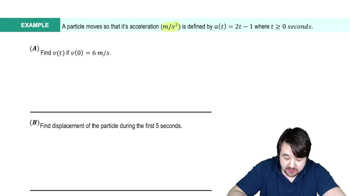
While displacement refers to the change in position from the start to the end of the interval, distance accounts for the total path traveled, regardless of direction. If the velocity function changes sign within the interval, it indicates that the object may reverse direction, which affects the total distance calculation. Thus, it is important to analyze the velocity function for any intervals where it may be negative.
Recommended video:
08:56
Using The Acceleration Function Example 1
Related Practice
Textbook Question

Where do they meet? Kelly started at noon (t=0) riding a bike from Niwot to Berthoud, a distance of 20 km, with velocity v(t) = 15 / (t + 1)² (decreasing because of fatigue). Sandy started at noon (t=0) riding a bike in the opposite direction from Berthoud to Niwot with velocity u(t) = 20 / (t + 1)² (also decreasing because of fatigue). Assume distance is measured in kilometers and time is measured in hours.


c. When do they meet? How far has each person traveled when they meet?

Textbook Question

Probe speed A data collection probe is dropped from a stationary balloon, and it falls with a velocity (in m/s) given by v(t) = 9.8t, neglecting air resistance. After 10 s, a chute deploys and the probe immediately slows to a constant speed of 10 m/s, which it maintains until it enters the ocean.


c. If the probe was released from an altitude of 3 km, when does it enter the ocean?

Textbook Question

Oscillating growth rates Some species have growth rates that oscillate with an (approximately) constant period P. Consider the growth rate function N'(t) = r+A sin 2πt/P, where A and r are constants with units of individuals/yr, and t is measured in years. A species becomes extinct if its population ever reaches 0 after t=0.


c. Suppose P=10, A=50, and r=5. If the initial population is N(0)=10, does the population ever become extinct? Explain.

Textbook Question

9–10. Velocity graphs The figures show velocity functions for motion along a line. Assume the motion begins with an initial position of s(0)=0. Determine the following.

c. The position at t=5

Textbook Question

Depletion of natural resources Suppose r(t) = r0e^−kt, with k>0, is the rate at which a nation extracts oil, where r0=10⁷ barrels/yr is the current rate of extraction. Suppose also that the estimate of the total oil reserve is 2×10⁹ barrels. 


c. Find the minimum decay constant k for which the total oil reserves will last forever.

2
views
Textbook Question

9–10. Velocity graphs The figures show velocity functions for motion along a line. Assume the motion begins with an initial position of s(0)=0. Determine the following.

c. The position at t=5