Back
Back
Problem 5.5.74
Definite integrals Use a change of variables or Table 5.6 to evaluate the following definite integrals.
∫₀^π/⁴ eˢᶦⁿ² ˣ sin 2𝓍 d𝓍
Problem 5.5.11
Use a substitution of the form u = a𝓍 + b to evaluate the following indefinite integrals.
∫(𝓍 + 1)¹² d𝓍
Problem 5.3.55
Definite integrals Evaluate the following integrals using the Fundamental Theorem of Calculus
∫π/₄^³π/⁴ (cot² 𝓍 + 1) d𝓍
Problem 5.3.71
Areas of regions Find the area of the region bounded by the graph of ƒ and the 𝓍-axis on the given interval.
ƒ(𝓍) = sin 𝓍 on [―π/4, 3π/4]
Problem 5.4.29
Average values Find the average value of the following functions on the given interval. Draw a graph of the function and indicate the average value.
ƒ(𝓍) = cos 𝓍 on [―π/2 , π/2]
Problem 5.2.63
Definite integrals from graphs The figure shows the areas of regions bounded by the graph of ƒ and the 𝓍-axis. Evaluate the following integrals.
∫₀ᶜ |ƒ(𝓍)| d𝓍
Problem 5.2.45
Definite integrals Use geometry (not Riemann sums) to evaluate the following definite integrals. Sketch a graph of the integrand, show the region in question, and interpret your result.
∫₀⁴ ƒ(𝓍) d𝓍, where ƒ(𝓍) = {5 if 𝓍 ≤ 2
3𝓍 ― 1 if 𝓍 > 2
Problem 5.5.5
When using a change of variables u = g(𝓍) to evaluate the definite integral ∫ₐᵇ ƒ(g(𝓍)) g' (𝓍) d(𝓍), how are the limits of integration transformed?
Problem 5.2.29
Area versus net area Graph the following functions. Then use geometry (not Riemann sums) to find the area and the net area of the region described.
The region between the graph of y = 1 - |x| and the x-axis, for -2 ≤ x ≤ 2
Problem 5.R.105e
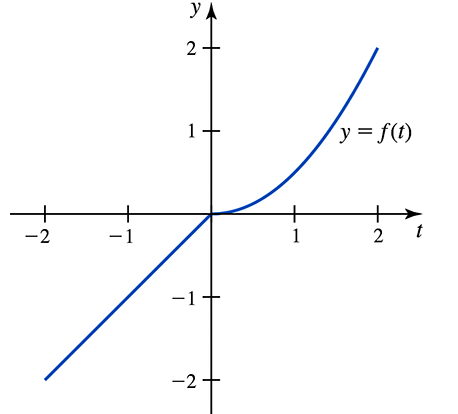
Area functions and the Fundamental Theorem Consider the function
ƒ(t) = { t if ―2 ≤ t < 0
t²/2 if 0 ≤ t ≤ 2
and its graph shown below. Let F(𝓍) = ∫₋₁ˣ ƒ(t) dt and G(𝓍) = ∫₋₂ˣ ƒ(t) dt.
(e) Evaluate F ''(―1) and F ''(1). Interpret these values.
Problem 5.R.13
Limit definition of the definite integral Use the limit definition of the definite integral with right Riemann sums and a regular partition to evaluate the following definite integrals. Use the Fundamental Theorem of Calculus to check your answer.
∫₀⁴ (𝓍³―𝓍) d𝓍
Problem 5.R.57
Evaluating integrals Evaluate the following integrals.
∫₀² (2𝓍 + 1)³ d𝓍
Problem 5.R.113c
Function defined by an integral Let ƒ(𝓍) = ∫₀ˣ (t ― 1)¹⁵ (t―2)⁹ dt .
(c) For what values of 𝓍 does ƒ have local minima? Local maxima?
Problem 5.R.66
Evaluating integrals Evaluate the following integrals.
∫ 𝓍 sin 𝓍² cos⁸ 𝓍² d𝓍
Problem 5.R.109
Geometry of integrals Without evaluating the integrals, explain why the following statement is true for positive integers n:
∫₀¹ 𝓍ⁿd𝓍 + ∫₀¹ ⁿ√(𝓍d𝓍) = 1
Problem 5.R.51
Evaluating integrals Evaluate the following integrals.
∫ 𝓍² cos 𝓍³ d𝓍
Problem 5.R.1c
Explain why or why not Determine whether the following statements are true and give an explanation or counterexample. Assume ƒ and ƒ' are continuous functions for all real numbers.
(c) ∫ₐᵇ ƒ'(𝓍) d𝓍 = ƒ(b) ―ƒ(a) .
Problem 5.R.89
Area of regions Compute the area of the region bounded by the graph of ƒ and the 𝓍-axis on the given interval. You may find it useful to sketch the region.
ƒ(𝓍) = 2 sin 𝓍/4 on [0, 2π]
Problem 5.R.107
Limits with integrals Evaluate the following limits.
lim ∫₂ˣ eᵗ² dt
𝓍→2 ---------------
𝓍 ― 2
Problem 5.R.1d
Explain why or why not Determine whether the following statements are true and give an explanation or counterexample. Assume ƒ and ƒ' are continuous functions for all real numbers.
(d) If ƒ is continuous on [a,b] and ∫ₐᵇ |ƒ(𝓍)| d𝓍 = 0 , then ƒ(𝓍) = 0 on [a,b] .
Problem 5.R.21
Properties of integrals Suppose ∫₁⁴ ƒ(𝓍) d𝓍 = 6 , ∫₁⁴ g(𝓍) d𝓍 = 4 and ∫₃⁴ ƒ(𝓍) d𝓍 = 2 . Evaluate the following integrals or state that there is not enough information.
∫₁³ ƒ(𝓍)/g(𝓍) d𝓍
Problem 5.R.91
Area versus net area Find (i) the net area and (ii) the area of the region bounded by the graph of ƒ and the 𝓍-axis on the given interval. You may find it useful to sketch the region.
ƒ(𝓍) = 𝓍⁴ ― 𝓍² on [―1, 1]
Problem 5.R.35
Find the intervals on which ƒ(𝓍) = ∫ₓ¹ (t―3) (t―6)¹¹ dt is increasing and the intervals on which it is decreasing.
Problem 5.R.87
Area of regions Compute the area of the region bounded by the graph of ƒ and the 𝓍-axis on the given interval. You may find it useful to sketch the region.
ƒ(𝓍) = 16―𝓍² on [―4, 4]
Problem 5.R.86
Evaluating integrals Evaluate the following integrals.
∫₀⁵ |2𝓍―8|d𝓍
Problem 5.R.9c
Integration by Riemann sums Consider the integral ∫₁⁴ (3𝓍― 2) d𝓍.
(c) Evaluate the definite integral by taking the limit as n →∞ of the Riemann sum in part (b).
Problem 5.R.102e
Function defined by an integral Let H (𝓍) = ∫₀ˣ √(4 ― t²) dt, for ― 2 ≤ 𝓍 ≤ 2.
(e) Find the value of s such that H (𝓍) = sH(―𝓍)
Problem 5.R.9b
Integration by Riemann sums Consider the integral ∫₁⁴ (3𝓍― 2) d𝓍.
(b) Use summation notation to express the right Riemann sum in terms of a positive integer n .
Problem 5.R.1g
Explain why or why not Determine whether the following statements are true and give an explanation or counterexample. Assume ƒ and ƒ' are continuous functions for all real numbers.
(g) ∫ ƒ' (g(𝓍))g' (𝓍) d(𝓍) = ƒ(g(𝓍)) + C .
Problem 5.R.96a
Velocity to displacement An object travels on the 𝓍-axis with a velocity given by v(t) = 2t + 5, for 0 ≤ t ≤ 4.
(a) How far does the object travel, for 0 ≤ t ≤ 4 ?