Ch. 5 - Integration
Briggs - Calculus: Early Transcendentals 3rd Edition
Briggs3rd EditionCalculus: Early TranscendentalsISBN: 9780136847243Not the one you use?Change textbook
Chapter 5, Problem 5.3.71

Areas of regions Find the area of the region bounded by the graph of Ζ’ and the 𝓍-axis on the given interval.


Ζ’(𝓍) = sin 𝓍 on [―π/4, 3Ο€/4]

Verified step by step guidance
1
Step 1: Understand the problem. We are tasked with finding the area of the region bounded by the graph of Ζ’(𝓍) = sin(𝓍) and the 𝓍-axis over the interval [―π/4, 3Ο€/4]. This involves integrating the function Ζ’(𝓍) = sin(𝓍) over the given interval.
Step 2: Set up the definite integral. The area can be calculated using the formula: absindx
Step 3: Evaluate the integral of sin(𝓍). Recall that the integral of sin(𝓍) is βˆ’cos(𝓍). Substitute this into the integral: absindx
Step 4: Apply the Fundamental Theorem of Calculus. Evaluate βˆ’cos(𝓍) at the bounds of the interval [―π/4, 3Ο€/4]. This means substituting the upper bound (3Ο€/4) and the lower bound (―π/4) into βˆ’cos(𝓍) and subtracting the results.
Step 5: Simplify the expression. Compute the values of βˆ’cos(3Ο€/4) and βˆ’cos(―π/4), then subtract them to find the area. Remember that the area is always positive, so take the absolute value if necessary.

Verified video answer for a similar problem:

This video solution was recommended by our tutors as helpful for the problem above.
Video duration:
2m
Was this helpful?

Key Concepts

Here are the essential concepts you must grasp in order to answer the question correctly.

Definite Integral

The definite integral of a function over a specified interval represents the net area between the graph of the function and the x-axis. It is calculated using the Fundamental Theorem of Calculus, which connects differentiation and integration. In this context, the area can be found by integrating the function Ζ’(𝓍) = sin 𝓍 from the lower limit of -Ο€/4 to the upper limit of 3Ο€/4.
Recommended video:
05:43
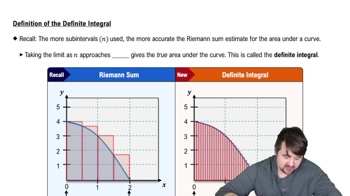
Definition of the Definite Integral

Area Under the Curve

The area under the curve of a function can be positive or negative depending on whether the function is above or below the x-axis. When calculating the total area, it is important to consider the absolute value of the areas where the function is negative, as these contribute to the overall area of the region bounded by the graph and the x-axis.
Recommended video:
05:59
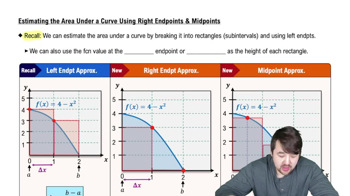
Estimating the Area Under a Curve with Right Endpoints & Midpoint

Properties of the Sine Function

The sine function, Ζ’(𝓍) = sin 𝓍, is periodic and oscillates between -1 and 1. Understanding its behavior over the interval [-Ο€/4, 3Ο€/4] is crucial for determining the area, as it crosses the x-axis at specific points. This knowledge helps in identifying the segments of the interval where the function is positive or negative, which is essential for accurate area calculation.
Recommended video:
06:21
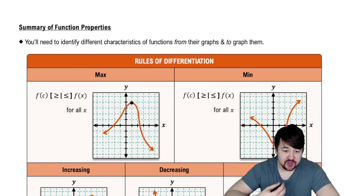
Properties of Functions
Related Practice
Textbook Question

Definite integrals Evaluate the following integrals using the Fundamental Theorem of Calculus


βˆ«β‚βΈ 8𝓍¹/Β³ d𝓍

1
views
Textbook Question

Definite integrals Use a change of variables or Table 5.6 to evaluate the following definite integrals.                                                                                                                         


 βˆ«β‚€^Ο€/⁴ e˒ᢦⁿ² Λ£ sin 2𝓍 d𝓍

Textbook Question

Definite integrals Evaluate the following integrals using the Fundamental Theorem of Calculus. Explain why your result is consistent with the figure.


βˆ«β‚€ΒΉ (𝓍² β€• 2𝓍 + 3) d𝓍


Textbook Question

Let Ζ’(𝓍) = c, where c is a positive constant. Explain why an area function of Ζ’ is an increasing function.

1
views
Textbook Question

Is xΒΉΒ² an even or odd function? Is sin xΒ² an even or odd function?

Textbook Question

Identifying Riemann sums Fill in the blanks with an interval and a value of n.


4

βˆ‘ Ζ’ (1 + k) β€’ 1 is a right Riemann sum for f on the interval [ ___ , ___ ] with

k = 1

n = ________ .

1
views