Ch. 5 - Integration
Briggs - Calculus: Early Transcendentals 3rd Edition
Briggs3rd EditionCalculus: Early TranscendentalsISBN: 9780136847243Not the one you use?Change textbook
Chapter 5, Problem 5.5.15a

Use Table 5.6 to evaluate the following indefinite integrals.                                                                                                               
                                                                                                                                                                  
 (a) ∫ e¹⁰ˣ d𝓍

Verified step by step guidance
1
Step 1: Recognize that the integral involves the exponential function e raised to a linear term (10x). The formula for the integral of e^(kx) is (1/k) * e^(kx) + C, where k is a constant and C is the constant of integration.
Step 2: Identify the constant k in the exponent. In this case, k = 10 because the exponent is 10x.
Step 3: Apply the formula for the integral of e^(kx). Substitute k = 10 into the formula, resulting in (1/10) * e^(10x) + C.
Step 4: Write the result in terms of the indefinite integral. The integral ∫ e^(10x) dx simplifies to (1/10) * e^(10x) + C.
Step 5: Remember to include the constant of integration (C) in your final answer, as this is an indefinite integral.

Verified video answer for a similar problem:

This video solution was recommended by our tutors as helpful for the problem above.
Video duration:
1m
Was this helpful?

Key Concepts

Here are the essential concepts you must grasp in order to answer the question correctly.

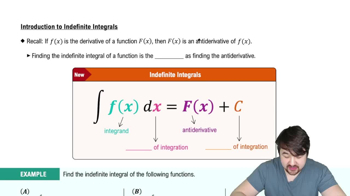
Indefinite Integrals

Indefinite integrals represent a family of functions whose derivative is the integrand. They are expressed with the integral sign followed by the function and the differential, and they include a constant of integration (C) since the derivative of a constant is zero. Understanding how to evaluate indefinite integrals is crucial for solving problems in calculus, as they provide the antiderivative of a function.
Recommended video:
05:04
Introduction to Indefinite Integrals

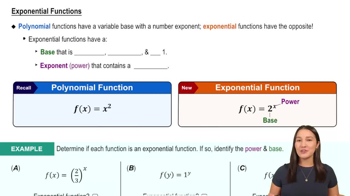
Exponential Functions

Exponential functions are mathematical functions of the form f(x) = a^x, where 'a' is a constant and 'x' is the variable. In calculus, the natural exponential function e^x is particularly important due to its unique property that the derivative of e^x is e^x itself. This property simplifies the process of integration, especially when dealing with integrals involving exponential terms.
Recommended video:
6:13
Exponential Functions

Integration Techniques

Integration techniques are methods used to evaluate integrals that may not be straightforward. Common techniques include substitution, integration by parts, and using integral tables. Familiarity with these techniques allows students to tackle a variety of integrals, including those involving exponential functions, and is essential for effectively solving calculus problems.
Recommended video:
06:18
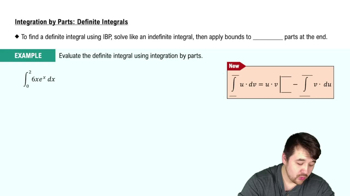
Integration by Parts for Definite Integrals
Related Practice
Textbook Question

Using properties of integrals Use the value of the first integral I to evaluate the two given integrals. 

I = βˆ«β‚€ΒΉ (𝓍³ ― 2𝓍) d𝓍 = ―3/4

(a) βˆ«β‚€ΒΉ (4𝓍―2𝓍³) d𝓍

Textbook Question

Bounds on an integral Suppose Ζ’ is continuous on [a, b] with Ζ’''(𝓍) > 0 on the interval. It can be shown that (b―a) Ζ’ [(a + b) /2] ≀ βˆ«β‚α΅‡ Ζ’(𝓍) d𝓍 ≀ (b―a) [ (Ζ’(a) + Ζ’(b)) /2]                                                         


(a) Assuming Ζ’ is nonnegative on [a, b], draw a figure to illustrate the geometric meaning of these inequalities. Discuss your conclusions. b. 

Textbook Question

The velocity in ft/s of an object moving along a line is given by v = Ζ’(t) on the interval 0 ≀ t ≀ 8 (see figure), where t is measured in seconds.

a) Divide the interval [0,8] into n = 2 subintervals, [0,4] and [4,8]. On each subinterval, assume the object moves at a constant velocity equal to the value of v evaluated at the midpoint of the subinterval, and use these approximations to estimate the displacement of the object on [0,8] (see part (a) of the figure)                                                                                                             


1
views
Textbook Question

Working with area functions Consider the function Ζ’ and the points a, b, and c.

(a) Find the area function A (𝓍) = βˆ«β‚Λ£ Ζ’(t) dt using the Fundamental Theorem.

Ζ’(𝓍) = ― 12𝓍 (𝓍―1) (𝓍― 2) ; a = 0 , b = 1 , c = 2

Textbook Question

Area functions The graph of Ζ’ is shown in the figure. Let A(x) = βˆ«β‚‹β‚‚Λ£ Ζ’(t) dt and F(x) = βˆ«β‚„Λ£ Ζ’(t) dt be two area functions for Ζ’. Evaluate the following area functions.

(a) A (―2)

Textbook Question

{Use of Tech} Midpoint Riemann sums with a calculator Consider the following definite integrals.

(a) Write the midpoint Riemann sum in sigma notation for an arbitrary value of n.


βˆ«β‚β΄ 2βˆšπ“ d𝓍