Ch. 5 - Integration
Briggs - Calculus: Early Transcendentals 3rd Edition
Briggs3rd EditionCalculus: Early TranscendentalsISBN: 9780136847243Not the one you use?Change textbook
Chapter 5, Problem 5.3.13a

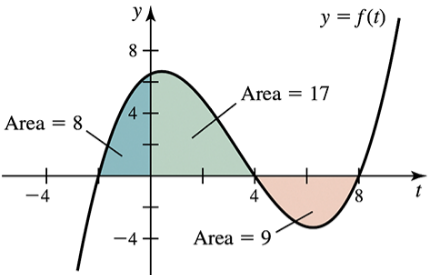
Area functions The graph of ƒ is shown in the figure. Let A(x) = ∫₋₂ˣ ƒ(t) dt and F(x) = ∫₄ˣ ƒ(t) dt be two area functions for ƒ. Evaluate the following area functions.
(a) A (―2)
Graph of a function with labeled areas: 8, 9, and 17, illustrating integral calculations over specified intervals.

Verified step by step guidance
1
Understand the problem: We are tasked with evaluating A(-2), where A(x) = ∫₋₂ˣ ƒ(t) dt. This means we need to calculate the definite integral of the function ƒ(t) from -2 to -2.
Recall the property of definite integrals: If the upper and lower limits of the integral are the same, the integral evaluates to 0. Mathematically, ∫ₐₐ ƒ(t) dt = 0.
Apply this property to A(-2): Since the limits of integration are both -2, the integral evaluates to 0.
Conclude that A(-2) = 0 based on the property of definite integrals.
No further calculations are needed as the result is determined by the fundamental property of definite integrals.

Verified video answer for a similar problem:

This video solution was recommended by our tutors as helpful for the problem above.
Video duration:
1m
Was this helpful?

Key Concepts

Here are the essential concepts you must grasp in order to answer the question correctly.

Definite Integral

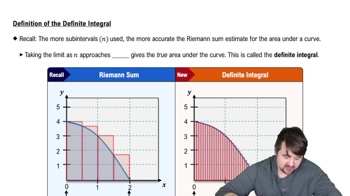
A definite integral represents the signed area under a curve between two points on the x-axis. It is calculated using the integral symbol and limits of integration, providing a numerical value that corresponds to the total area, accounting for areas above and below the x-axis. In this context, A(x) and F(x) are defined as definite integrals of the function ƒ(t) over specified intervals.
Recommended video:
05:43
Definition of the Definite Integral

Area Function

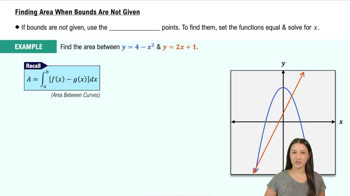
An area function, such as A(x) or F(x), is a function that gives the accumulated area under a curve from a specific starting point to a variable endpoint x. It is defined as the integral of a function from a constant lower limit to x, allowing for the evaluation of how the area changes as x varies. This concept is crucial for understanding how to compute areas based on the graph provided.
Recommended video:
05:06
Finding Area When Bounds Are Not Given

Fundamental Theorem of Calculus

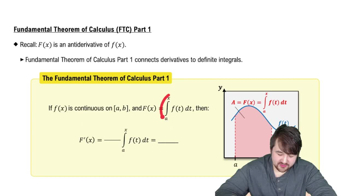
The Fundamental Theorem of Calculus links the concept of differentiation and integration, stating that if F is an antiderivative of f on an interval, then the integral of f from a to b is equal to F(b) - F(a). This theorem is essential for evaluating area functions, as it allows us to compute the definite integral by finding the antiderivative of the function and applying the limits of integration.
Recommended video:
06:11
Fundamental Theorem of Calculus Part 1
Related Practice
Textbook Question

Using properties of integrals Use the value of the first integral I to evaluate the two given integrals. 

I = ∫₀¹ (𝓍³ ― 2𝓍) d𝓍 = ―3/4

(a) ∫₀¹ (4𝓍―2𝓍³) d𝓍

Textbook Question

Area functions for linear functions Consider the following functions ƒ and real numbers a (see figure).

(a) Find and graph the area function A (𝓍) = ∫ₐˣ ƒ(t) dt .

ƒ(t) = 2t + 5 , a = 0

2
views
Textbook Question

Use Table 5.6 to evaluate the following indefinite integrals.                                                                                                               


 (a) ∫ e¹⁰ˣ d𝓍

Textbook Question

{Use of Tech} Midpoint Riemann sums with a calculator Consider the following definite integrals.

(a) Write the midpoint Riemann sum in sigma notation for an arbitrary value of n.


∫₁⁴ 2√𝓍 d𝓍

Textbook Question

Sigma notation Express the following sums using sigma notation. (Answers are not unique.)

(a) 1 + 2 + 3 + 4 + 5

Textbook Question

Using properties of integrals Use the value of the first integral I to evaluate the two given integrals. 

I = ∫₀^π/2 (cos θ ― 2 sin θ) dθ = ―1

(a) ∫₀^π/2 (2 sin θ ― cos θ) dθ