Ch. 5 - Integration
Briggs - Calculus: Early Transcendentals 3rd Edition
Briggs3rd EditionCalculus: Early TranscendentalsISBN: 9780136847243Not the one you use?Change textbook
Chapter 5, Problem 5.3.2

Suppose F is an antiderivative of ƒ and A is an area function of ƒ. What is the relationship between F and A?

Verified step by step guidance
1
Understand the definitions: An antiderivative F of a function ƒ is a function such that the derivative of F is equal to ƒ, i.e., F'=ƒ. An area function A of ƒ represents the accumulated area under the curve of ƒ from a fixed point to a variable point x.
Recall the Fundamental Theorem of Calculus: It states that if A(x) is the area function of ƒ, then A'(x) = ƒ(x). This means the derivative of the area function is the original function ƒ.
Recognize the connection: Since F is an antiderivative of ƒ, and A'(x) = ƒ(x), it follows that A(x) and F(x) differ by a constant. Specifically, A(x)=F(x)+C, where C is a constant.
Interpret the constant C: The constant C depends on the choice of the lower limit of integration in the area function A(x). If the lower limit is changed, the value of C will adjust accordingly.
Summarize the relationship: The area function A(x) is essentially an antiderivative of ƒ, but it includes a constant term that depends on the lower limit of integration. Both F and A are closely related through this constant adjustment.

Verified video answer for a similar problem:

This video solution was recommended by our tutors as helpful for the problem above.
Video duration:
2m
Was this helpful?

Key Concepts

Here are the essential concepts you must grasp in order to answer the question correctly.

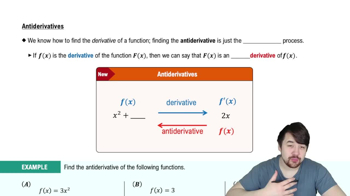
Antiderivative

An antiderivative of a function f is another function F such that the derivative of F is equal to f, i.e., F' = f. This means that F represents a family of functions whose slopes at any point correspond to the values of f. Antiderivatives are essential in calculus for solving problems related to integration and finding areas under curves.
Recommended video:
05:50
Antiderivatives

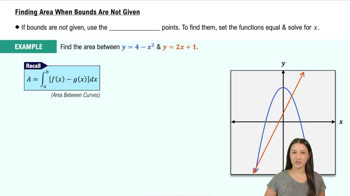
Area Function

An area function A associated with a function f typically represents the accumulated area under the curve of f from a specific point to a variable endpoint. Mathematically, it is defined as A(x) = ∫[a to x] f(t) dt, where a is a constant. The area function is crucial for understanding how the total area changes as the endpoint varies, linking it to the concept of integration.
Recommended video:
05:06
Finding Area When Bounds Are Not Given

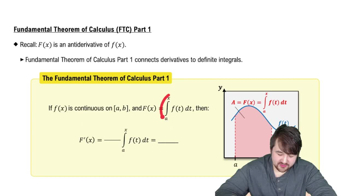
Fundamental Theorem of Calculus

The Fundamental Theorem of Calculus connects differentiation and integration, stating that if F is an antiderivative of f on an interval [a, b], then the integral of f from a to b can be computed as F(b) - F(a). This theorem establishes that the area function A is directly related to the antiderivative F, as A(x) = F(x) - F(a), illustrating the deep relationship between these concepts.
Recommended video:
06:11
Fundamental Theorem of Calculus Part 1
Related Practice
Textbook Question

Definite integrals Use a change of variables or Table 5.6 to evaluate the following definite integrals.                                                                                                                         


 ∫π/₄^π/² (cos 𝓍) / (sin² 𝓍) d𝓍

Textbook Question

Evaluate ∫₀² 3𝓍² d𝓍 and ∫₋₂² 3𝓍² d𝓍. 

Textbook Question

Area functions from graphs The graph of ƒ is given in the figure. A(𝓍) = ∫₀ˣ ƒ(t) dt and evaluate A(2), A(5), A(8), and A(12).


1
views
Textbook Question

Integrals with sin² 𝓍 and cos² 𝓍 Evaluate the following integrals.                                                                                                             


 ∫₋π^π cos² 𝓍 d𝓍