Ch. 5 - Integration
Briggs - Calculus: Early Transcendentals 3rd Edition
Briggs3rd EditionCalculus: Early TranscendentalsISBN: 9780136847243Not the one you use?Change textbook
Chapter 5, Problem 5.5.57

Definite integrals Use a change of variables or Table 5.6 to evaluate the following definite integrals.                                                                                                                         
                                                                                                                                                                              
 ∫π/₄^π/² (cos 𝓍) / (sin² 𝓍) d𝓍

Verified step by step guidance
1
Step 1: Recognize that the integral involves a trigonometric function ratio. Rewrite the integrand (cos(𝓍) / sin²(𝓍)) in terms of simpler trigonometric expressions. Notice that cos(𝓍) / sin²(𝓍) can be expressed as (1 / sin²(𝓍)) * cos(𝓍).
Step 2: Use substitution to simplify the integral. Let u = sin(𝓍), which implies that du = cos(𝓍) d𝓍. This substitution transforms the integral into ∫ (1 / u²) du.
Step 3: Rewrite the limits of integration in terms of u. When 𝓍 = π/₄, u = sin(π/₄) = √2/2. When 𝓍 = π/₂, u = sin(π/₂) = 1. The new limits of integration are from u = √2/2 to u = 1.
Step 4: Integrate the transformed function ∫ (1 / u²) du. Recall that the integral of 1/u² is -1/u. Apply this formula to compute the antiderivative.
Step 5: Evaluate the definite integral by substituting the limits of integration into the antiderivative. Compute the result as [-1/u] evaluated from u = √2/2 to u = 1.

Verified video answer for a similar problem:

This video solution was recommended by our tutors as helpful for the problem above.
Video duration:
3m
Was this helpful?

Key Concepts

Here are the essential concepts you must grasp in order to answer the question correctly.

Definite Integrals

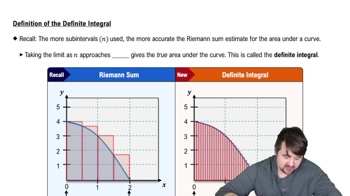
A definite integral represents the signed area under a curve between two specified limits. It is denoted as ∫[a, b] f(x) dx, where 'a' and 'b' are the lower and upper limits, respectively. The result of a definite integral is a number that quantifies the accumulation of the function's values over the interval [a, b]. Understanding how to evaluate definite integrals is crucial for solving problems in calculus.
Recommended video:
05:43
Definition of the Definite Integral

Change of Variables

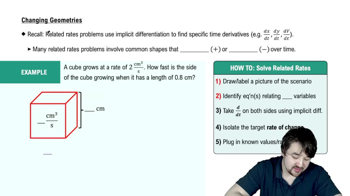
Change of variables, or substitution, is a technique used to simplify the evaluation of integrals. By substituting a new variable for an existing one, the integral can often be transformed into a more manageable form. This method involves calculating the derivative of the new variable and adjusting the limits of integration accordingly. It is particularly useful when dealing with complex functions or integrals that are difficult to evaluate directly.
Recommended video:
06:35
Changing Geometries

Trigonometric Identities

Trigonometric identities are equations that involve trigonometric functions and are true for all values of the variables involved. These identities, such as sin²(x) + cos²(x) = 1, can be used to simplify integrals involving trigonometric functions. Recognizing and applying these identities can make it easier to manipulate and evaluate integrals, especially when they appear in definite integrals like the one presented in the question.
Recommended video:
7:17
Verifying Trig Equations as Identities
Related Practice
Textbook Question

Suppose F is an antiderivative of ƒ and A is an area function of ƒ. What is the relationship between F and A?

Textbook Question

Evaluate ∫₀² 3𝓍² d𝓍 and ∫₋₂² 3𝓍² d𝓍. 

Textbook Question

Indefinite integrals Use a change of variables or Table 5.6 to evaluate the following indefinite integrals. Check your work by differentiating.                                                                                  


 ∫ 2 / (𝓍√4𝓍² ―1) d𝓍 , 𝓍 > ½ 

1
views
Textbook Question

Area functions from graphs The graph of ƒ is given in the figure. A(𝓍) = ∫₀ˣ ƒ(t) dt and evaluate A(2), A(5), A(8), and A(12).


1
views
Textbook Question

Integrals with sin² 𝓍 and cos² 𝓍 Evaluate the following integrals.                                                                                                             


 ∫₋π^π cos² 𝓍 d𝓍