Ch. 5 - Integration
Briggs - Calculus: Early Transcendentals 3rd Edition
Briggs3rd EditionCalculus: Early TranscendentalsISBN: 9780136847243Not the one you use?Change textbook
Chapter 5, Problem 5.3.93

Area functions from graphs The graph of Ζ’ is given in the figure. A(𝓍) = βˆ«β‚€Λ£ Ζ’(t) dt and evaluate A(2), A(5), A(8), and A(12).


<IMAGE>

Verified step by step guidance
1
Step 1: Understand the problem. The function A(𝓍) = βˆ«β‚€Λ£ Ζ’(t) dt represents the area under the curve of Ζ’(t) from t = 0 to t = 𝓍. To evaluate A(2), A(5), A(8), and A(12), we need to calculate the definite integral of Ζ’(t) over the respective intervals.
Step 2: Analyze the graph. The graph of Ζ’(t) consists of distinct geometric shapes: a quarter-circle with radius 2 (from t = 0 to t = 4), a triangle (from t = 4 to t = 8), and another triangle (from t = 8 to t = 12). The areas of these shapes can be calculated using geometric formulas.
Step 3: Calculate A(2). Since t = 2 lies within the quarter-circle, calculate the area of the sector of the circle from t = 0 to t = 2 using the formula for the area of a sector: (1/4)Ο€rΒ², where r = 2. Adjust the calculation for the portion of the quarter-circle up to t = 2.
Step 4: Calculate A(5) and A(8). For A(5), sum the area of the quarter-circle (from t = 0 to t = 4) and the area of the triangle from t = 4 to t = 5. For A(8), sum the area of the quarter-circle and the entire triangle from t = 4 to t = 8. Use the formula for the area of a triangle: (1/2)base Γ— height.
Step 5: Calculate A(12). For A(12), sum the areas of the quarter-circle, the triangle from t = 4 to t = 8, and the triangle from t = 8 to t = 12. Note that the triangle from t = 8 to t = 12 has a negative area because it is below the t-axis. Use the same triangle area formula, but subtract the result.

Verified video answer for a similar problem:

This video solution was recommended by our tutors as helpful for the problem above.
Video duration:
3m
Was this helpful?

Key Concepts

Here are the essential concepts you must grasp in order to answer the question correctly.

Definite Integral

A definite integral represents the signed area under a curve between two points on the x-axis. It is denoted as βˆ«β‚α΅‡ f(t) dt, where 'a' and 'b' are the limits of integration. This concept is crucial for calculating the area function A(x) = βˆ«β‚€Λ£ f(t) dt, which accumulates the area from 0 to x.
Recommended video:
05:43
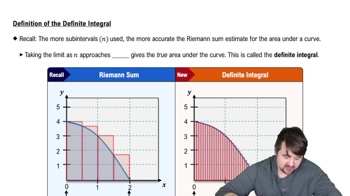
Definition of the Definite Integral

Area Under the Curve

The area under the curve of a function f(t) from a to b can be interpreted as the total accumulation of the function's values over that interval. This area can be positive or negative depending on whether the function is above or below the x-axis. Understanding how to calculate these areas is essential for evaluating A(2), A(5), A(8), and A(12) from the given graph.
Recommended video:
05:59
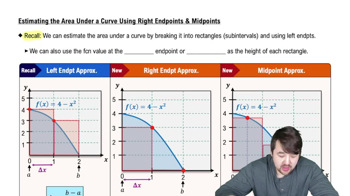
Estimating the Area Under a Curve with Right Endpoints & Midpoint

Piecewise Functions

A piecewise function is defined by different expressions based on the input value. In this case, the function f(t) has distinct segments, including linear and circular arcs, which require separate calculations for each interval. Recognizing how to handle these segments is vital for accurately computing the area function A(x) at specified points.
Recommended video:
05:36
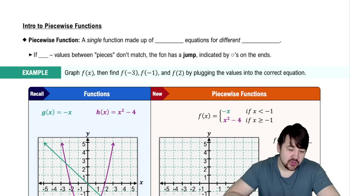
Piecewise Functions
Related Practice
Textbook Question

Suppose F is an antiderivative of Ζ’ and A is an area function of Ζ’. What is the relationship between F and A?

Textbook Question

Definite integrals Use a change of variables or Table 5.6 to evaluate the following definite integrals.                                                                                                                         


 βˆ«Ο€/β‚„^Ο€/Β² (cos 𝓍) / (sinΒ² 𝓍) d𝓍

Textbook Question

Integrals with sinΒ² 𝓍 and cosΒ² 𝓍 Evaluate the following integrals.                                                                                                             


 βˆ«β‚‹Ο€^Ο€ cosΒ² 𝓍 d𝓍