
Ch. 5 - Integration
Briggs - Calculus: Early Transcendentals 3rd Edition
Briggs3rd EditionCalculus: Early TranscendentalsISBN: 9780136847243Not the one you use?Change textbook
Chapter 5, Problem 5.2.53.d

Properties of integrals Suppose βˆ«β‚€Β³Ζ’(𝓍) d𝓍 = 2 , βˆ«β‚ƒβΆΖ’(𝓍) d𝓍 = ―5 , and βˆ«β‚ƒβΆg(𝓍) d𝓍 = 1. Evaluate the following integrals.
(d) βˆ«β‚†Β³ (Ζ’(𝓍) + 2g(𝓍)) d𝓍

Verified step by step guidance
1
Step 1: Recognize that the integral βˆ«β‚†Β³ (Ζ’(𝓍) + 2g(𝓍)) d𝓍 involves reversing the limits of integration. When the limits are reversed, the integral changes sign. Thus, βˆ«β‚†Β³ (Ζ’(𝓍) + 2g(𝓍)) d𝓍 = -βˆ«β‚ƒβΆ (Ζ’(𝓍) + 2g(𝓍)) d𝓍.
Step 2: Use the property of linearity of integrals to split the integral into two separate integrals: -βˆ«β‚ƒβΆ (Ζ’(𝓍) + 2g(𝓍)) d𝓍 = -[βˆ«β‚ƒβΆ Ζ’(𝓍) d𝓍 + βˆ«β‚ƒβΆ 2g(𝓍) d𝓍].
Step 3: Factor out the constant 2 from the second integral using the constant multiple rule: -[βˆ«β‚ƒβΆ Ζ’(𝓍) d𝓍 + 2βˆ«β‚ƒβΆ g(𝓍) d𝓍].
Step 4: Substitute the given values for the integrals: βˆ«β‚ƒβΆ Ζ’(𝓍) d𝓍 = -5 and βˆ«β‚ƒβΆ g(𝓍) d𝓍 = 1. Replace these values into the expression: -[-5 + 2(1)].
Step 5: Simplify the expression inside the brackets and apply the negative sign outside the brackets to find the result.

Verified video answer for a similar problem:

This video solution was recommended by our tutors as helpful for the problem above.
Video duration:
3m
Was this helpful?

Key Concepts

Here are the essential concepts you must grasp in order to answer the question correctly.

Properties of Definite Integrals

Definite integrals have several key properties, including linearity, which states that the integral of a sum is the sum of the integrals. This means that ∫(f(x) + g(x)) dx = ∫f(x) dx + ∫g(x) dx. Additionally, the integral from a to b can be expressed as the negative of the integral from b to a, i.e., ∫_a^b f(x) dx = -∫_b^a f(x) dx.
Recommended video:
05:43
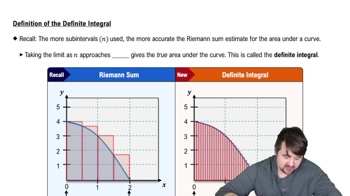
Definition of the Definite Integral

Change of Limits in Integrals

When evaluating integrals, changing the limits of integration affects the sign of the result. Specifically, if you reverse the limits of integration, the value of the integral becomes negative. For example, ∫_a^b f(x) dx = -∫_b^a f(x) dx, which is crucial when evaluating integrals with limits that are not in increasing order.
Recommended video:
06:35
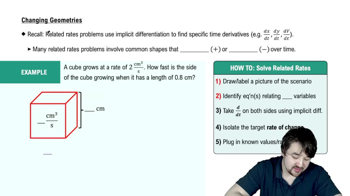
Changing Geometries

Linear Combination of Functions

A linear combination of functions involves adding or subtracting functions multiplied by constants. In the context of integrals, if you have a function like (f(x) + 2g(x)), you can evaluate the integral of this combination by integrating each function separately and applying the constants accordingly. This property simplifies the evaluation of integrals involving multiple functions.
Recommended video:
07:17
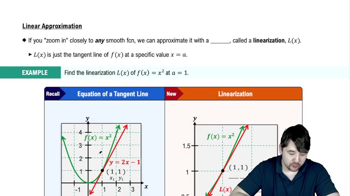
Linearization
Related Practice
Textbook Question

Explain why or why not Determine whether the following statements are true and give an explanation or counterexample.

(c) The average value of a linear function on an interval [a, b] is the function value at the midpoint of [a, b] .

Textbook Question

{Use of Tech} Approximating definite integrals Complete the following steps for the given integral and the given value of n. 

(d) Determine which Riemann sum (left or right) underestimates the value of the definite integral and which overestimates the value of the definite integral.


βˆ«β‚β· 1/𝓍 d𝓍 ; n = 6

Textbook Question

Properties of integrals Use only the fact that βˆ«β‚€β΄ 3𝓍 (4 ―𝓍) d𝓍 = 32, and the definitions and properties of integrals, to evaluate the following integrals, if possible.

(d) βˆ«β‚€βΈ 3𝓍(4 ― 𝓍) d(𝓍)

Textbook Question

Use Table 5.6 to evaluate the following indefinite integrals.                                                                                                               


 (d) ∫ cos 𝓍/7 d𝓍

Textbook Question

Explain why or why not Determine whether the following statements are true and give an explanation or counterexample.                                                                          

                                                                                                                                                                                     (c) The functions p(𝓍) = sin 3𝓍 and q(𝓍) = 4 sin 3𝓍 are antiderivatives of the same function. 

Textbook Question

Use Table 5.6 to evaluate the following definite integrals.                                                                                                                    

 (c) βˆ«β‚ƒβˆšβ‚‚^⁢ d𝓍/(𝓍² ―9)

1
views